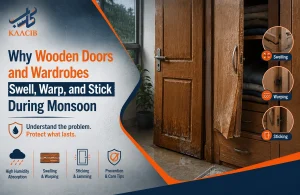
Every July, the bedroom door starts sticking. It takes a shoulder against the top corner to close it properly. By October it frees up on its own. By the following July it’s back. Three seasons of this, and the household has accepted it as what wood does in Karachi during monsoon.
The wardrobe in the spare room stopped closing flush two seasons ago. The drawer beneath the bed requires real effort to open now. Both were attributed to humidity, and both were left.
What the door needed three seasons ago was two millimeters taken from its top edge during the first monsoon it stuck. Better still, it needed two millimeters of clearance at installation that the original carpenter didn’t leave. What it has now, after three seasons of being forced shut by a shoulder, is a top hinge pulling loose from the frame and a hanging angle that has shifted enough that the sticking pattern is no longer what it was. The monsoon didn’t accumulate the damage. The forcing did.
Karachi’s Monsoon Humidity Pushes Wood Past Its Expansion Limit
Wood absorbs moisture from the air around it. At 70 percent relative humidity, wood absorbs enough moisture to swell measurably across its width and thickness. Karachi’s monsoon humidity regularly reaches 80 to 90 percent during peak weeks. At those levels, the expansion is significant enough to close whatever gap existed between the door and its frame at installation.
A door fitted in February, when Karachi’s indoor humidity runs between 40 and 55 percent, is fitted to the wood’s near-driest state. A good installation leaves a gap of two to three millimeters on the top edge and latch side specifically to accommodate what July will bring. In many homes, that gap is never left. The door is fitted clean, the carpenter leaves, and the result looks precise. The first monsoon shows where the precision was applied and where the allowance wasn’t.
Wooden doors stick during monsoon in Karachi because wood absorbs moisture from humid air and expands. Karachi’s monsoon humidity regularly reaches 80 to 90 percent, which causes wood to swell significantly more than it does in the dry months. Doors installed during the dry season are fitted with minimal expansion gap. When monsoon humidity arrives, the door expands but the frame cannot accommodate it, producing sticking at the edges where the expansion is greatest.
The frame is not passive in this. Door frames absorb moisture from the wall they’re set into as well as from the air. A frame that has absorbed moisture and swelled inward reduces the opening the door has to fit through, compounding the expansion of the door itself. A door that sticks at the top edge may be reacting to both the door swelling outward and the frame swelling inward simultaneously.
Where a Door Sticks Tells a Carpenter What Is Causing It
A carpenter looking at a sticking door doesn’t reach for the plane first. The sticking location is read before anything is touched. The top edge, latch side, and bottom corner each point to a different cause. The fix for one problem may be wrong for anoth
A door sticking at the top edge has swelled across its widest horizontal dimension. Wood expands more across the grain than along it, and the top edge of a door represents the widest continuous cross-section. When monsoon humidity peaks, the top edge is where the expansion announces itself first and most forcefully against the frame. A door that requires lifting at the handle to close is usually catching at the top corner. It is sticking at the top for exactly this reason.
A door sticking on the latch side is a different situation. Either the door has swelled on its latch edge specifically, or the frame has moved as well as the door. Latch-side sticking in a door that closed cleanly last year usually points to frame movement. The surrounding wall has absorbed moisture, and the frame has shifted slightly inward. The gap that accommodated the door in dry conditions no longer exists. Addressing the door without checking the frame produces a repair that fails when the frame position changes again.
A door catching at the bottom corner, particularly one that drags across the floor, often reflects floor settlement alongside a door that was already a close fit at the base. The floor may have lifted slightly. The door may also have sagged on its hinges. In either case, the clearance that existed at installation has closed. Planing the door bottom is sometimes the fix. Adjusting the hinge positions to restore the door’s hanging angle is sometimes the more appropriate one.
Where a sticking door rubs against the frame identifies the cause. A door sticking at the top edge has swelled across its widest dimension due to moisture absorption. A door sticking on the latch side indicates either latch-edge swelling or frame movement. A door catching at the bottom corner often reflects floor settlement combined with a fit that had minimal original clearance.
Wooden wardrobes during Karachi’s monsoon humidity develop loose joints, drawers that catch, and doors that no longer hang square. Adhesive-only joints, which are common in Pakistani home carpentry, absorb expansion force without the mechanical fasteners that would hold them in position under sustained humidity cycling. Extended high humidity accelerates the joint fatigue that accumulated through previous seasons. The installation decisions that created the conditions for loose wardrobe joints during monsoon are covered in common woodworking problems in Karachi homes.
Monsoon Swelling Reverses, Warping Does Not
A door that sticks in July and opens freely in October is swelling. Wood absorbed moisture, expanded, and will contract when the humidity drops. Nothing permanent has happened. The door will behave the same way next monsoon unless the installation gap is corrected.
A door that sticks in July and continues to stick in November, or that has developed a visible bow across its face, has warped. Warping happens when moisture absorption becomes uneven across the door’s two faces. One side stays wetter longer in some environments. A face exposed to a damp wall, a bathroom door whose outer face absorbs moisture while the inner face dries faster, or a door in a room with inconsistent ventilation can all create that imbalance. The differential expansion between the two faces introduces a twist or bow that the wood retains after drying because the fibers on the wetter side compressed slightly under the differential force. Drying doesn’t restore the original flat geometry.
Forcing a swollen door converts temporary swelling into permanent warping faster than humidity alone does. A swollen door is already under moisture stress. Pushing from one corner, lifting the handle, or slamming it shut adds uneven mechanical force. The hinge screws pull in their mortises. The door’s hanging angle shifts incrementally. One face of the door receives more mechanical stress than the other. Over multiple seasons, what was reversible seasonal expansion becomes a door that no longer hangs square regardless of the season.
Temporary monsoon door swelling reverses when humidity drops. Permanent warping occurs when moisture absorption is uneven across the door’s two faces, causing one face to expand more than the other and producing a bow or twist that doesn’t self-correct. Repeatedly forcing a swollen door introduces uneven mechanical stress that converts temporary swelling into permanent warping over multiple monsoon seasons.
Wooden furniture and fixed woodwork are affected year-round, not just during monsoon peaks. Those forces are covered in detail in the causes of wooden furniture damage in Karachi homes.
What Can Be Done During Monsoon and What Must Wait Until Humidity Drops
A carpenter called to a sticking door during peak monsoon faces a timing problem. Some repairs can be made immediately. Lubricating hinge pins, tightening hinge screws, and repairing stripped screw holes reduce friction without removing wood. They reduce the physical resistance without removing wood. They don’t need to wait.
Planning does. Planning a door during the weeks when monsoon humidity is at its peak removes wood from a door that is at its most swollen state. A door planned to fit in July fits in July and rattles in October. The wood will contract when humidity drops, and the gap that was correct when the door was swollen becomes too large when the door returns to its dry dimensions. Many local installations don’t leave that gap. The door is fitted clean, the carpenter leaves, and the fit looks precise.
The correct approach to planning depends on the severity of the sticking. Where the sticking is moderate and the door can still be closed with reasonable effort, waiting until October and assessing the gap in dry conditions produces the most accurate result. The carpenter can measure the true dry-state clearance, identify the gap that should have been left at installation, and remove the minimum material necessary to achieve it. Sometimes the sticking is severe enough that the door cannot be closed at all. In those cases, conservative planning during monsoon may be necessary. Only a small amount of wood is removed, leaving the door slightly tight until humidity drops.
A sticking door can be partly addressed during monsoon by lubricating hinges, tightening hinge screws, and checking whether the frame has moved. Planning during peak humidity removes wood from a door at its most swollen state. When the humidity drops and the wood contracts, the door may rattle because too much material was removed. Conservative planning during peak sticking, or assessment and full correction after the monsoon, produces a lasting result.
A Carpentry Assessment After Monsoon Fixes the Season Just Passed and Prevents the Next One
Post-monsoon assessments are most useful between October and December. Humidity has dropped, wood has contracted toward its dry-state dimensions, and the gaps that should exist between door and frame can be measured accurately. What the monsoon season revealed about the original installation becomes readable when the door is back to the size it was fitted at.
A post-monsoon door assessment at Kaacib starts with the hanging angle. Three seasons of forcing a sticking door shifts the hinge positions incrementally. The top hinge pulls outward from the frame mortise, the bottom hinge compresses slightly, and the door’s hanging angle changes. Planing without correcting the hanging angle planes the wrong edge. The door that sticks at the top because it hangs at the wrong angle will still stick at the top after planing if the hinge position isn’t addressed first.
From the hanging angle, the assessment moves to the frame. A frame that has moved in its wall opening due to moisture absorption needs to be assessed for its stable dry-state position before the door is adjusted to it. A frame that continues to move with humidity cycles needs different treatment than one that has settled into a stable position.
Wardrobe joints and drawer slides are assessed for the fatigue that the monsoon season accumulated. A joint that worked loose during peak humidity but appears to have closed again as conditions dried is a joint that will work looser in the next monsoon. The adhesive bond has fatigued. The joint needs to be opened, cleaned of old adhesive, and re-bonded with mechanical reinforcement. It should not be left alone simply because it appears to have resolved.
Kaacib’s carpentry assessment and door repair in Karachi covers the full post-monsoon sequence: hanging angle, frame condition, door planing, and wardrobe-joint assessment. The goal is to establish the correct dry-state clearances before the following July tests them again.
The Door Forced Shut in July Needs Frame Work in Year Five
A door that needed two millimeters planed from its top edge in year one is a straightforward repair. The door is removed, the excess material is taken from the top edge, the door is re-hung, and it closes cleanly for the rest of the monsoon season and correctly through the following one.
A door that was forced shut every July for five years is a different job. The top hinge has pulled outward from its mortise. The screw holes have elongated under the repeated leverage of the door being lifted at the handle. The door now hangs at an angle it wasn’t installed at. The sticking pattern has shifted because the hanging angle has changed. Planing the top edge no longer addresses the cause, even though the door still sticks there. The problem is now the hinge position rather than the wood itself. The frame mortises need filling and re-cutting before the hinges can be repositioned. Before the door can be planed, the frame needs to be right.
Year one: two millimeters off the top edge. Year five: hinge repositioning, frame mortise repair, reassessment of the hanging angle, then planing.
The door spent five years getting there one forced closing at a time. Each July, the shoulder against the corner transferred a small amount of force into the top hinge. Each October, when the door freed up, nothing visible confirmed that anything had changed. The damage accumulated in the interval between the monsoon sticking and the dry-season relief, hidden inside the elongating screw holes and the incrementally shifting hinge plate.
A sticking door noticed in year one is a morning’s work. The same door in year five is a job that takes the frame apart before it can put the door right.