2026
2026


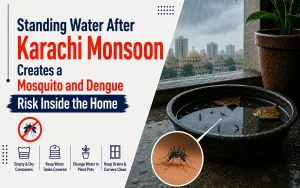
There are more mosquitoes this month than there were in June. The household has noticed it at dusk, near the cooler, on the rooftop after evening prayers. The assumption is that this is just what monsoon does to a city like Karachi. Drains overflow, gutters back up, water sits in the streets, and mosquitoes follow.
That explains a flooded street. It doesn’t explain a cooler tray that hasn’t been emptied since last week.
Aedes mosquitoes, the species behind this season’s dengue concern, don’t need a flooded street. They need still water, and not very much of it. A cooler tray. A saucer under a potted plant. The lip of a rooftop tank that hasn’t been checked since the rain started. Water that has been sitting on this property, not water that traveled in from somewhere else.
The Property Is Producing These Mosquitoes, Not Just Hosting Them
A mosquito egg laid in still water can reach the biting adult stage in roughly seven to ten days in warm standing water. The timeline shortens or stretches with heat, but it doesn’t reset.
Karachi’s monsoon doesn’t arrive as one heavy rain followed by dry weather. It comes in spells, with breaks between them long enough for a household to stop thinking about water but not long enough for a cooler tray or a plant saucer to dry out completely. A tray topped up twice a week never gets the uninterrupted dry stretch that would break a breeding cycle once one has started.
This is the part that gets missed. A household can be diligent about visible flooding, about drains and low-lying courtyard corners, and still have an active breeding site three feet from the back door because nobody associates a cooler tray with mosquito control. The water doesn’t look like a problem. It looks like water in a tray.
The Obvious Sources: Coolers, Containers, Saucers
Some breeding sites are easy to find once someone thinks to look. These are usually the first tier a household can clear on its own, no equipment beyond a bucket and five minutes.
Desert coolers running through August hold water in the base tray whether the unit is in use or not. A cooler left filled between uses, common when the unit is switched on and off through the day rather than run continuously, gives that tray days of undisturbed standing water, conditions Aedes mosquitoes are well suited to breed in.
Flowerpot saucers do the same thing at a smaller scale. Water collects under the pot after watering or rain, and unlike the soil above it, the saucer has nowhere to drain. A balcony or rooftop with a dozen potted plants can carry a dozen small breeding sites, each one easy to miss because each one is small.
Discarded containers are the easiest to overlook because nobody placed them there to collect water. Buckets left outside after a task, tyres stored against a boundary wall, plastic sheeting or tarpaulin left folded with a crease that holds rain. None of it was meant to hold water. All of it does.
A weekly check of these three categories, emptied and wiped rather than just tipped out, since eggs can adhere to the sides of a container above the waterline, deals with the sites a household can reach and control without anyone else’s help.
The Sources Most Households Miss: Tanks, Gutters, and Renovation Debris
The obvious sites get checked because they’re visible from a normal position in the house. This next tier sits at height, out of the way, or behind a task that already feels finished, and where drainage, covers, or maintenance have slipped, that’s exactly what lets them hold water longest.
Rooftop and sintex tanks are the least suspected of the group. A tank itself is usually sealed, but a cover that has cracked, warped, or come loose from its seat can leave an entry point most residents never check, especially after a season of heat and rain cycling the material. That same compromised cover is also the condition that allows construction dust and monsoon runoff to reach the stored water supply , a contamination problem that runs alongside the breeding concern but requires its own check. the same compromised cover can also allow contamination of stored water The overflow pipe discharges at ground level, and where that discharge point isn’t graded to drain away, the water it releases collects in place rather than running off.
Parapet ledges and roof gutters hold water for a related but different reason: they were built to drain it away, and in an older or poorly maintained roof, they don’t anymore. A gutter with a slight sag, or a parapet ledge where the slope has settled over the years, keeps water sitting after the rest of the roof has drained. This is worth separating from a different problem in the same location.
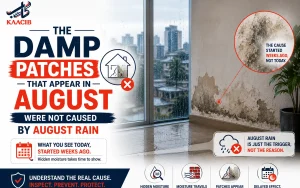
Water sitting on a parapet or gutter surface is a breeding concern in its own right. The same water is also, in many cases, the source of the damp patches appearing on interior walls , it finds its way in through cracked fillets and unsealed junctions rather than running off. A household checking for damp patches inside the house is looking at what the water did after it got in. Checking the gutter itself is about what the water is doing while it’s still sitting there.
Renovation and repair work left mid-progress through monsoon adds a category most advisories skip entirely. A property under repair collects water in places that don’t normally hold it: an open drum of mixed material left uncovered, a tarpaulin sheet with a low point, a stack of tyres or pipes stored on-site before installation. Work paused for the season doesn’t pause the water collecting around it.
None of these three sites is difficult to identify once someone knows to look. What makes them different from a cooler tray or a plant saucer is access. A resident can tip out a saucer in ten seconds. Getting a clear look inside a rooftop tank, along a gutter run, or across a construction site takes more effort, sometimes a ladder, sometimes tools nobody keeps in the house.
What You Can Clear Yourself and What Needs Professional Treatment
The two tiers above split cleanly on one question: can this be reached and fully cleared with what’s already in the house.
Cooler trays, plant saucers, and loose containers pass that test. Emptying them weekly, and wiping rather than just tipping, is enough to keep these sites from completing a breeding cycle. No equipment is needed beyond the willingness to do it on a schedule rather than when the water becomes visible.
Tank interiors, gutter runs, and construction debris generally don’t pass. A tank needs to be opened and checked rather than just drained from the outside, since a tank refills within days of the next rain, and draining alone doesn’t address a cover or seal problem that will let the same conditions recur. A gutter that’s sagging or poorly sloped won’t hold less water next week just because it was emptied this week; the fix is structural, not a one-time clearing. A construction site with multiple water-holding surfaces needs treatment applied across all of them at once, not a single container checked in isolation.
This split decides whether pest control is worth calling in during the season rather than waiting for it to end. A property where every breeding site falls into the first tier can be managed with a weekly household routine. A property carrying even one site from the second tier is carrying a source a weekly check won’t reach, and that source continues to offer breeding conditions until the underlying problem, a bad cover, a sagging gutter, standing water on a work site, is corrected.
What a Kaacib Inspection Adds to the Household Check
A household check confirms whether water is sitting somewhere. It doesn’t always confirm whether that water is actively breeding, since a tray can be dry one week and refilled the next without anyone tracking whether a cycle completed in between. A Kaacib inspection checks for larvae directly at each site rather than assuming presence from standing water alone, which is the difference between clearing water and confirming a site is no longer active.
The inspection also treats the property as one system rather than a list of separate spots. A tank cover repaired without checking whether the gutter below it is also holding water leaves half the job done. Visiting every site in a single pass, from the ones a household already checks to the ones it doesn’t, catches a source that would otherwise get missed simply because nobody thought to look at the gutter and the tank on the same visit.
Where a site can’t be fully drained or physically corrected during the visit, a construction site with multiple water-holding surfaces, for example, larviciding is used to interrupt the breeding cycle while the underlying repair, a new cover, a regraded gutter, is arranged separately. Each visit ends with a note on what was found and what still needs addressing, so a follow-up isn’t guesswork.
Kaacib’s pest control services in Karachi cover this inspection, from the sites a household checks weekly to the ones that need a ladder, a tool, or a second visit to confirm are actually clear.
The Question Worth Answering This Week
Checking a cooler tray, a rooftop tank lid, and a gutter run takes an afternoon, and most of what’s found belongs to the household’s own weekly routine from here on. What matters is knowing which sites that routine actually covers.
A property where every water source is within easy reach, a tray, a saucer, a bucket, can be kept clear without anyone else’s involvement. A property with even one source that’s sealed, elevated, structurally compromised, or spread across an active work site is carrying something a weekly check can’t resolve on its own. Telling the two apart is the actual task this week, not waiting to see whether the mosquitoes get worse.