2026
2026


Nothing has failed. The lights are on. The AC is running. A breaker tripped twice during rain events but reset without complaint. A wall near the kitchen junction box feels slightly damp. The household has been through a week of monsoon rain and the electrical system appears intact.
A week of sustained monsoon rain is not a neutral event for home wiring. It is a test, and the results are already visible. The breaker that tripped twice detected something. The warm socket near the bathroom has been announcing it. The damp wall near the junction box is still telling it to anyone willing to read it.
Pre-monsoon electrical inspection looks for what might fail. Mid-monsoon electrical inspection looks for what the rain has already found. The week of rain that just passed did not create new problems. It found the ones already there.
Four Signs a Week of Rain Has Left in the Electrical System
A household emerging from a week of monsoon rain has usually noticed one or two things and attributed them to the season. Normal monsoon behavior. Nothing to worry about. Some of those attributions are correct. Others are the start of a condition that will compound with every additional rain event through August and September.
Four specific signs are worth checking after a sustained rain period.
A breaker that tripped during rain events and was reset. The reset worked. The breaker is back in position. What it detected when it tripped may still be present.
A socket or switch plate that felt warm after power returned. Power cuts and restorations are common during monsoon. The warmth that appeared at a socket face after restoration is the terminal behind it carrying more resistance than it should.
A brief smell of burning plastic that appeared and faded. It lasted a few minutes and then stopped. Stopping is not resolution. It is the wiring at a stressed point cooling after a brief overheating event.
A damp patch near a junction box, wiring run, or the main distribution panel. The patch may be attributed to seepage or plumbing. Its location makes it an electrical concern as well.
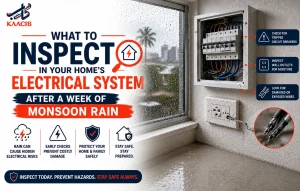
After a week of monsoon rain in Karachi, four things are worth checking: whether circuit breakers tripped during rain events, whether switch plates or socket covers feel warm, and whether any smell of burning plastic appeared and faded. Damp patches near junction boxes, wiring runs, or the main switchboard are the fourth.
None of these are post-monsoon items. They are mid-season signals, and the signs that appeared in the first week of rain will worsen through the second and third if the underlying conditions are not addressed. Mid-monsoon, these signs carry more urgency because the rain has now confirmed them rather than predicted them. What each sign indicates before monsoon arrives, and what to look for during a pre-monsoon inspection, is covered in Signs Your Home Wiring Needs Inspection Before Monsoon.
A Tripped Breaker During Monsoon Is Not Always a Normal Reset
Two different things cause a breaker to trip during rain. The first is a genuine circuit overload, too many appliances drawing too much current from one circuit. Normal. The reset is correct. Nothing else needs doing.
The second cause is a ground fault: moisture has entered the circuit somewhere and created a current path that shouldn’t exist. The breaker detected that path and tripped to break it. Resetting removes the trip but not the moisture, and not the fault path.
A breaker that trips once during a rain event and not again may have detected a momentary condition. A breaker that has tripped twice on the same circuit during rain events has detected the same fault condition twice. The circuit has a recurring moisture-related fault.
A circuit breaker tripping during monsoon rain in Karachi is not always a normal event requiring only a reset. A breaker detecting a ground fault trips as a safety response to moisture creating an unintended current path. Resetting without identifying the moisture source leaves the ground fault in place. A breaker tripping again under the same rain conditions has detected the same fault twice.
Warm sockets and switch plates are a separate reading. After each K-Electric restoration event during the week, a voltage spike entered the home circuit, stressing terminal connections. A terminal that was borderline before the season may have absorbed enough spike stress through a week of repeated outages to now carry elevated resistance under normal load. Heat at the socket face is resistance converting electrical energy to warmth instead of delivering it. Not a minor nuisance; it is the terminal reporting its own condition.
Restoration spikes also degrade appliance components and UPS battery cycles across the season. What to Do With Your Home’s Electrical System After a Long Power Cut explains how that cumulative damage accumulates and what to check after extended outages.
A warm socket or switch plate after monsoon rain indicates a terminal connection carrying elevated resistance. After repeated voltage spikes from K-Electric restoration events during a week of monsoon outages, terminal connections that were already under stress may now produce heat under normal load.
A Damp Wall Near Wiring Is an Electrical Problem, Not Just a Plumbing One
A damp patch on the bedroom wall is a seepage or waterproofing problem. A damp patch on the wall adjacent to the main distribution panel is both of those things and something else as well.
Moisture conducts electricity, and a wall surface feeling damp carries moisture deeper in the substrate as well. In Karachi’s older residential buildings, wiring commonly runs through wall chases without protective conduit, which means moisture in the wall can reach cable insulation directly.
Insulation that is dry functions correctly. The same insulation with moisture contact carries current along pathways it was not designed for. The result is a leakage current that the earthing system is meant to intercept and route safely to ground.
In homes where the earthing system was properly installed and has been maintained, that interception works. In homes where earthing connections were never verified or have corroded through years of load-shedding voltage cycling, the leakage current has nowhere safe to go.
A damp patch near a switchboard, junction box, or wiring run during monsoon is an electrical concern, not only a waterproofing one. In Karachi’s older buildings, wiring in unprotected wall chases means moisture can reach cable insulation directly. When the earthing system is incomplete, a fault from that contact has no safe path to ground.
The moisture near electrical infrastructure enters through the same entry points as all monsoon seepage: roof junctions, parapet edges, and window frame separations. Why Walls Seep During Monsoon and What Waterproofing Actually Fixes examines those pathways and the waterproofing methods used to close them before moisture reaches the wiring inside the wall.
When Mid-Monsoon Electrical Conditions Need Immediate Attention
Not every sign from the past week requires an electrician this week. Some warrant monitoring. Three conditions require professional attention before the next rain event.
A breaker that has tripped more than twice on the same circuit during rain events. One trip may be coincidental. Two trips on the same circuit under similar conditions indicate a recurring fault. The third trip may not reset cleanly.
A socket cover, switch plate, or junction box cover that is hot, not warm, to the touch, or that shows discoloration around its edges. Discoloration means heat has been present at that point repeatedly. Hot rather than warm means the resistance has reached the level where the component is at risk of failure or fire.
A damp wall within one meter of any electrical fitting, junction box, or the main panel. One meter is not arbitrary. It is the zone where moisture in the substrate can reach wiring without being visible at the fitting itself.
Mid-monsoon electrical conditions needing immediate attention include a breaker tripping more than twice on the same circuit during rain and any socket or switch cover that is hot to the touch or shows discoloration. Damp walls within one meter of any electrical fitting or the main switchboard also qualify. All three worsen with each additional rain event and should not wait for post-monsoon inspection.
Kaacib’s mid-monsoon electrical inspection in Karachi addresses these conditions during the season, not after it.
How We Inspect Mid-Monsoon Electrical Conditions at Kaacib
Pre-monsoon inspection looks for vulnerabilities. Mid-monsoon inspection looks for what rain has already reached.
The inspection begins with the breaker record. Circuits that tripped during the week are identified and each breaker mechanism is tested against its rated load. One tripping below its rated threshold has absorbed internal stress and will continue to do so.
From the breaker panel, the inspection follows the circuits that tripped to their most moisture-adjacent points. Junction boxes on external walls are opened. Terminal condition inside each box is checked for heat marks, corrosion, and moisture entry. Socket and switch faces on bathrooms, kitchens, and external walls are removed from the wall and examined from behind.
Wall moisture is measured adjacent to the circuits showing stress. A moisture meter reading in the wall near a junction box establishes whether moisture is present in the substrate independent of whether the surface feels damp. Surface dryness and substrate dryness are not the same condition.
Earthing continuity is tested separately. A week of monsoon restoration spikes can corrode earthing connections that were intact at the start of the season. A continuity check confirms whether the earth path from the switchboard to the earth electrode is still complete.
The Electrical Conditions Found in August Are Easier to Address Than the Ones Found in October
A terminal connection identified as heat-stressed in August is a terminal replacement before the next rain event. The circuit is opened, the terminal is replaced, the connection is retested. Contained job. One visit.
The same terminal found in October has absorbed six more weeks of monsoon spikes and moisture stress. It may have damaged the socket it serves, the upstream junction box, and the wiring at the terminal point. The replacement now includes assessment of what the failed terminal affected during the weeks it was running at elevated resistance.
A breaker identified as detecting a recurring ground fault in August can be traced to its moisture source while the season is still active and the fault is reproducible. The moisture entry point is identifiable because it is still receiving rain. The same ground fault diagnosed in October, after the rain has stopped and the moisture has begun to dry, requires reconstruction of conditions that no longer exist. Monsoon rain finds what was already in the wiring. August is when the finding is recent, the conditions are active, and the repair is still a contained response to a known condition. October is when the finding has been sitting for six more weeks.