2026
2026


The dark patch appeared on the bedroom wall sometime in the last week. Near the ceiling, spreading outward from the corner. The household connected it immediately to the heavy rain that came through last Tuesday. The monsoon brought moisture, the moisture produced mold, and now it needs to be cleaned.
Two of those three things are correct.
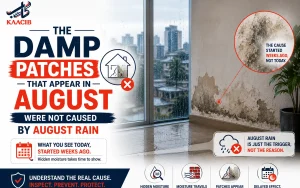
The mold on the wall last Tuesday was not new. What’s visible from across the room has been growing for two to three weeks at minimum. Last Tuesday’s rain added moisture to something already established, not something new. The patch that appeared this week was already present last week, too small to notice in low light. The week before that, it was beginning. Before that, moisture arrived and the first spores found what they needed.
For preventing mold after a moisture event, the 48-hour response window matters most. Learn more in the companion guide on how to clean your home after monsoon flooding. What follows here covers the weeks after that window closes, which for most Karachi homes in August, it already has.
Mold Begins Growing Within 48 Hours of Moisture Contact, Not When It Becomes Visible
Mold spores exist in every indoor environment at concentrations that cause no problems under dry conditions. When moisture reaches a suitable surface and humidity stays above germination threshold, growth begins within 24 to 48 hours. Not visible growth. Microscopic colonization that produces no sign a resident would notice.
Growth from microscopic establishment to visible size takes one to two weeks. Last Tuesday’s rain did not create the patch. It may have added moisture to something already active, or simply coincided with the colony reaching visible scale after weeks of quiet growth.
Karachi’s August humidity compresses the establishment timeline. Outdoor humidity regularly exceeds 80 percent. Interior surfaces without active dehumidification stay above the moisture level that sustains mold growth even between rain events. Initial establishment happens quickly. Growth then continues without the dry periods that would limit it elsewhere.
Monsoon mold begins growing within 24 to 48 hours of moisture reaching a wall, ceiling, grout, or fabric surface. Indoor surfaces in Karachi’s August conditions do not dry adequately between rain spells. What becomes visible in August was established two to three weeks before it was large enough to notice from across the room.
Cleaning the Visible Patch Removes the Surface but Leaves the Colony
Mold grows in two directions simultaneously. The visible surface layer is the reproductive part, the layer producing spores. Below it, root-like structures called hyphae penetrate into plaster, grout, or wall material beneath the painted surface.
Bleach applied to the surface kills the visible growth and oxidizes the pigment. The wall appears clean. Hyphae embedded beneath the plaster sit below the depth bleach reaches in standard application. When moisture remains in the wall, and in Karachi’s August humidity it almost certainly does, regrowth follows from those roots. Return to visible scale typically takes two to three weeks.
Surface treatment removes visible growth but leaves root structure embedded in the wall beneath. When moisture remains, regrowth follows within days to weeks. Surface treatment is not remediation. It removes discoloration and eliminates the visible layer without reaching what established beneath.
Mold smell appears before visible growth because mold produces volatile organic compounds from its earliest stages. Persistent musty smell without visible patches signals growth in a concealed location, inside a wall cavity, behind a fitting, under a cabinet base, or in an area without direct light. The smell is not a warning of something coming. It is evidence of something current.
Five Surfaces in a Karachi Home Where Monsoon Mold Establishes Before It’s Noticed
Mold concentrates where moisture is sustained, ventilation is limited, and the substrate absorbs and retains humidity. Five locations produce the most consistently late-detected growth in Karachi homes.
Bathroom ceiling grout and corners. Bathroom ceilings experience condensation from every shower. Without exhaust ventilation, absent in many Karachi homes, moisture lingers on ceiling surfaces for hours. Grout between ceiling tiles absorbs this preferentially. Mold establishes in grout well before spreading onto tile surfaces. When it becomes visible on tiles, the grout channels have been colonized for weeks.
Interior face of exterior walls near seepage points. Seepage entering through roof junctions, parapet edges, or window frame separations travels through the wall cavity before reaching the interior surface. Cavity moisture supports hidden growth on the back of internal plaster, on insulation, and on wall framing. The interior face may look dry or show only a faint damp patch. Active seepage produces hidden growth well before the interior surface reveals it. For a detailed explanation of seepage entry points, see why walls seep during monsoon and what waterproofing actually fixes.
Under bathroom and kitchen cabinet bases. Water from basin overflow, drain leaks, or floor cleaning accumulates under cabinet bases in limited airflow. Cabinet baseboards sitting on damp floor surfaces develop mold on their underside and at the base of the cabinet sides. The growth stays invisible without removing the baseboard or looking beneath the unit.
AC return air grilles and duct interiors. AC systems draw air through rooms where mold has established on walls and ceilings, pulling spores through the return air path. Spores settling on grille surfaces or inside ductwork colonize and redistribute through every room the system serves. Musty smell strongest when the AC switches on is often duct distribution, not wall mold nearby. For duct mold entering the distribution system, AC duct cleaning in Karachi addresses what surface wall cleaning cannot.
Fabric stored in wardrobes without ventilation. Clothing and bedding stored during August absorbs ambient humidity through the enclosed space. Fabric washed and stored slightly damp, common in Karachi’s slow-drying monsoon conditions, provides an immediate substrate. Mold appears as small spots on fabric surfaces, persistent smell when the wardrobe opens, or discoloration on lighter material.
High-risk surfaces include bathroom ceiling grout, exterior wall interior faces near seepage, underside of bathroom and kitchen cabinet bases, AC grilles and duct interiors, and fabric in unventilated storage. All five share sustained moisture and limited airflow, producing growth invisible from normal room positions until the colony is well established.
When Monsoon Mold Needs Professional Remediation Rather Than Surface Cleaning
Surface cleaning with an antifungal product addresses one scenario: a small patch on a non-porous surface, glazed tile, sealed concrete, glass, or metal. The colony must not have penetrated the substrate. The moisture source must already be stopped. Under those conditions, surface treatment can work.
Wall plaster, ceiling render, bathroom grout, wood surfaces, and painted drywall are all porous. On any of these, root structure develops below the paint layer within days of establishment. After three weeks in Karachi’s August humidity, it has penetrated to a depth surface products cannot reach.
Patch size adds another variable. Spread exceeding a square meter means root network extends well beyond the visible edge. Hyphae extend outward in all directions from visible growth. Treating only what is visible misses the perimeter zone where the colony is actively expanding. Return of a patch after previous surface treatment signals establishment below treatment depth. Persistent smell after visible mold has been cleaned means the colony exists somewhere the cleaning did not reach.
Professional remediation is needed when the area exceeds a square meter. Porous surfaces also require professional remediation. The same applies when smell persists after visible mold is cleaned, when the patch has regrown after prior treatment, or when mold is suspected inside wall cavities or ductwork. Surface cleaning suits only small patches on genuinely non-porous surfaces where the moisture source is confirmed closed.
Kaacib’s mold remediation and post-monsoon cleaning in Karachi begins with full surface assessment including concealed areas. Unsalvageable material is removed. Salvageable surfaces are treated to below-threshold moisture content. The moisture source is confirmed closed before any restoration begins.
How We Approach Mold Remediation at Kaacib
Kaacib starts a mold remediation job with a moisture assessment, not a cleaning one. Finding all affected surfaces comes second to identifying what feeds the growth. Cleaning without closing the moisture source produces a clean room for two weeks before the same conditions produce the same result.
Both visible and concealed surfaces are covered. A moisture meter applied around and beyond the visible patch identifies how far moisture has traveled through wall material, often well past the visible mold boundary. Adjacent ceiling surfaces are checked for elevated readings. Where the patch sits near a junction box or access panel, areas behind fittings and inside wall cavities are examined directly.
Once extent is mapped, materials are assessed for salvageability. Plaster sustaining growth for more than two to three weeks, with moisture content above threshold, may have structural integrity affected beyond cosmetic damage. Paint and surface coatings over affected plaster are removed before treatment. Applying antifungal agents through a paint layer treats the surface while leaving colonized substrate beneath.
Salvageable surfaces receive antifungal treatment at the concentration and contact time needed to reach the colony depth found during assessment. Drying follows, targeting moisture content below the level supporting regrowth. In Karachi’s August conditions, active dehumidification is required. Surface restoration waits until moisture readings confirm conditions can no longer sustain the colony.
The Mold Cleaned in August Returns in September If the Moisture Source Stays Open
A bedroom wall cleaned in August, bleach applied, patch removed, surface repainted, can show mold again six weeks later without anything being done incorrectly. The surface treatment worked as intended. What remained unaddressed was the moisture source. A roof junction open since June. Condensation forming on that wall face every night. Seepage feeding the cavity since the first July rain.
What was cleaned in August was not eliminated. The surface layer was removed. Root structure beneath the surface survived. In September, with humidity still elevated and the moisture source still active, the surface layer regrew from those roots. The patch appearing in September looks like a new problem. It is the continuation of an August problem not fully resolved.
Mold returning after treatment is not evidence that treatment failed. It signals that treatment addressed the symptom while the cause remained in place. Sustained moisture from an identifiable source determines whether a patch cleaned in August reappears in September. A closed source with fully treated growth produces a wall that stays clean. An open source with surface-only treatment produces a wall cleaned repeatedly and showing the same patch each time. The mold visible this August has been growing since July. The moisture feeding it has been entering the building since June or earlier. Surface treatment is the last step in a remediation sequence, not the first. Walls that stay clean are ones where the source was closed and growth was treated to full depth. Surfaces were restored only after moisture readings confirmed conditions can no longer support regrowth.