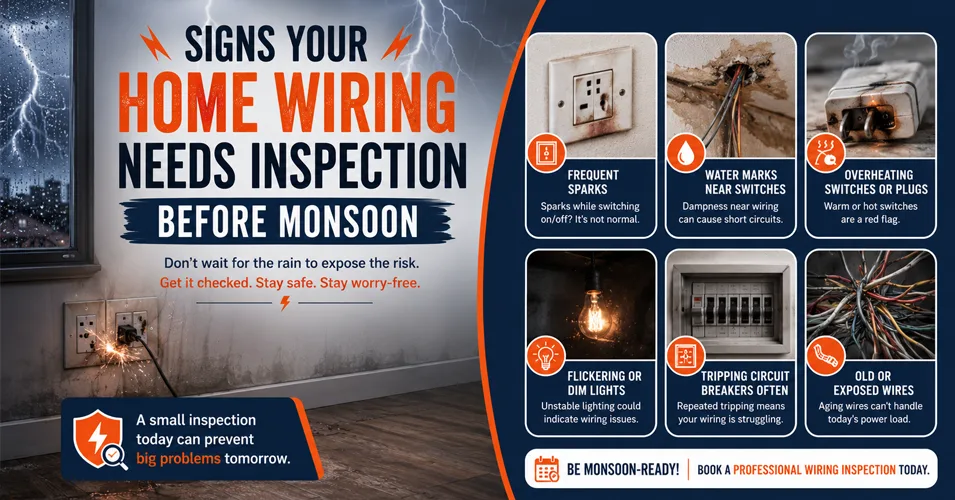
Every year, the same sequence plays out across Karachi. The first heavy rain of the season hits. Switchboards in ground-floor kitchens trip. Water finds its way into junction boxes along external walls. A socket near a bathroom exhaust starts crackling. What felt like a routine monsoon morning becomes something more serious.
The wiring didn’t fail because of the rain. It was already compromised. The rain found the weakness that dry weather had been hiding.
Most homes in Karachi carry electrical infrastructure that was installed a decade or two ago, sometimes longer. The loads that wiring was designed for, a few lights, a refrigerator, a single AC unit, bear little resemblance to what runs through the same circuits today. Insulation degrades. Junction box seals crack. Earthing systems that were installed without verification sit untested behind walls. None of this registers as a problem until moisture provides the path that was always waiting.
July is not when wiring problems begin. July is when they surface.
Cracked Insulation Carries No Risk Until Moisture Arrives
Electrical insulation is plastic or rubber. Both materials harden and crack over time, particularly in environments where temperature swings are significant and humidity is persistent. Karachi’s summers followed by monsoon create exactly those conditions, year after year, inside the wall cavities where wiring runs.
A wire whose insulation has cracked carries current normally in dry conditions. The cracked section is exposed, but if nothing conductive comes near it, nothing happens. When moisture enters that wall cavity, through a crack in the plaster, through a poorly sealed AC sleeve, through a roof junction that has started to give, the cracked insulation becomes a point where current can travel somewhere it shouldn’t.
Inside the home, the signs of aging wiring are rarely the wire itself. They appear at the connection points: the switchboard, the socket, the junction box. A socket that sparks briefly when a plug is inserted. A switch plate that feels warmer than it should after the AC has been running for an hour. A junction box cover that has developed a slight discoloration around the edges. A circuit breaker that trips under a load that didn’t used to trip it. These are not malfunctions. They’re the wiring telling the home something that the home hasn’t relayed to its occupants yet.
A Warm Switch Plate Is Not a Minor Annoyance
Some wiring conditions announce themselves through signs that are easy to dismiss. The sign gets attributed to a bad socket, a cheap appliance, or an old building being an old building. The underlying cause stays in place.
A switch plate or socket that feels warm to the touch. Heat at a switch or socket is the wiring connection at that point carrying more resistance than it should. A correctly functioning connection generates no perceptible heat. When the metal contacts inside a socket or switch loosen over time, or corrode, resistance at that point rises and heat follows. In a dry month, this is a nuisance. When monsoon humidity reaches that connection, the degraded contact becomes a more immediate problem.
A breaker that trips more often than it used to. Circuit breakers trip when they detect more current than the circuit is rated to carry. A breaker that has started tripping under loads it previously handled without issue is either responding to a genuine overload from additional appliances on the circuit, or detecting a fault current that wasn’t there before. The distinction matters. Resetting the breaker and moving on addresses neither cause.
Flickering lights that aren’t connected to a specific appliance starting. Lights that dim or flicker when the AC compressor starts are responding to the momentary load, normal behavior in many homes. Lights that flicker independently, without any large appliance cycling, point toward a loose connection somewhere in the circuit between the switchboard and the fitting. That loose connection generates heat and arcing under load, without producing sparks visible from outside the wall.
Discoloration around socket or switch plates. Yellowing or brown marks around the edge of a socket cover that weren’t there when it was installed indicate heat has been present at that point repeatedly. The plastic cover has been heating and cooling over many cycles. This is not an aesthetic issue.
A persistent burning smell that appears briefly and then fades. A smell of burning plastic that appears for a few minutes, particularly when a high-draw appliance starts, and then disappears is often dismissed as something external or temporary. It is the insulation on a wire overheating at a stressed point. The smell fading doesn’t mean the condition has resolved. It means the wire has cooled.
Karachi’s Load-Shedding Cycles Age Wiring Faster Than Time Does
The signs in the previous section appear in homes everywhere. In Karachi, three building-specific conditions make them more likely and more consequential.
Older residential buildings across Karachi’s established neighborhoods, DHA, Gulshan, PECHS, North Nazimabad, parts of Clifton, were wired decades ago to specifications that reflected both the electrical loads and the materials of that time. Aluminum wiring, which was common before copper became standard in residential construction, develops loose connections at terminal points as it expands and contracts with heat cycles. Buildings that haven’t had wiring assessments since construction carry whatever was installed, whatever has corroded, and whatever additional connections were made during renovations without full circuit reviews.
Earthing is the second factor. A properly earthed electrical system provides a path for fault current to travel safely to the ground rather than through a person or an appliance. Many older Karachi homes were built with earthing connections that were either installed incorrectly, never verified after installation, or have corroded over the years to the point of offering no functional protection. This is not visible from inside the home. The switch plates look identical whether the earthing behind them works or doesn’t.
The third factor is voltage. Karachi’s frequent load-shedding cycles, power cut, restoration, power cut, restoration, subject home wiring and components to repeated voltage spikes as supply is restored. Over years, these spikes degrade the insulating material on wires, weaken circuit breaker mechanisms, and accelerate corrosion at connection terminals. A home that has been through ten years of regular load-shedding is carrying wiring that has aged faster than its installation year suggests. The relationship between wiring condition and the broader electrical load on a home is covered in detail in how home electrical systems affect energy consumption.
What a Pre-Monsoon Electrical Inspection Actually Covers
An electrical inspection before monsoon doesn’t follow the same path as an emergency fault repair. The starting point is a survey of the home’s wiring history and current load, not a search for an active fault. Active faults announce themselves. What the inspection looks for is what hasn’t announced itself yet.
The switchboard is examined first, the condition of the breakers, whether the ratings match the circuits they protect, whether any circuits show signs of heat at the terminal connections. A breaker that has been tripping intermittently and resetting is noted alongside one that hasn’t tripped in years but whose terminal shows discoloration. Both are data points.
From the switchboard, the inspection follows the circuits to the points of highest moisture risk: the kitchen, the bathroom, any socket or switch on an external wall, and the area around AC installations. AC sleeves cut through external walls and are sealed at installation. That sealant deteriorates. Water that enters through a degraded AC sleeve reaches the wiring inside the wall before it becomes visible on the surface.
Junction boxes, the connection points where wiring branches off from main circuits to individual rooms or appliances, are opened and examined for moisture entry, corroded connections, and insulation condition at the point where wires terminate. In homes with older wiring, this is often where the most significant deterioration is found, because junction boxes are accessible from inside wall cavities and are the points where multiple wires meet under a single enclosure.
The earthing system is tested separately. A continuity check confirms whether the earth path from the switchboard to the earthing electrode is intact. In a home where the earth path is broken or corroded, this test identifies the condition before monsoon arrives rather than after a fault current has no safe path to follow.
How We Approach Electrical Inspections at Kaacib
Pre-monsoon electrical work at Kaacib starts with the building, not the switchboard. The age of the wiring, the type of construction, the location of high-moisture points, and whether any recent renovation work touched the electrical circuits, these establish the inspection context before any panel is opened.
The inspection follows the sequence established by risk. Switchboard condition is assessed first, then the circuits serving the kitchen, bathrooms, and external wall installations. Every junction box on those circuits is opened. Every socket and switch plate on moisture-adjacent walls is removed from the wall and examined from behind. The signs described in this article, heat, discoloration, loose terminals, degraded insulation at connection points, are what the inspection is specifically looking for, not checking off a general list.
Earthing is tested with a continuity meter rather than assumed from the presence of an earth wire in the circuit. A wire labeled as earth that doesn’t have a verified path to the ground electrode offers no protection. This distinction is the most frequently overlooked element of pre-monsoon electrical readiness in Karachi homes.
Where faults are found, the inspection report documents the location, the nature of the condition, and the urgency of repair before recommending any work. Kaacib’s home electrical inspection in Karachi covers the full pre-monsoon assessment, from the switchboard through to the earthing system, identifying what needs attention before the first rain arrives and what can be addressed as part of routine maintenance.
The Inspection Window Closes When the First Rain Arrives
Karachi’s monsoon doesn’t announce an exact date. It tends to arrive with a spell that nobody was quite ready for, the drain that backed up, the switchboard that tripped, the smell from behind the wall that hadn’t been there before.
The homes that come through that first spell without incident are usually the ones where someone had looked at the electrical system before the rain made looking necessary. Not a full rewire. Not a month-long project. A systematic check of the switchboard, the moisture-adjacent circuits, the junction boxes, and the earthing, the same work that becomes reactive and more expensive once a fault has already expressed itself through a damaged appliance or a tripped breaker that won’t reset.
The window between now and the first significant rain is the only time this work is straightforward. Once humidity rises, once water has entered a wall cavity, once a fault has already occurred, the inspection becomes a damage assessment rather than a prevention measure.
An electrician looking at a home in June finds conditions. An electrician called in August finds consequences.