Why does a faucet keep dripping even after it’s been tightened?
The handle goes firm. The drip slows, sometimes stops. A day later it’s back. Tightening it again produces the same result: a brief pause, then the same steady sound against the sink at night.
The instinct to tighten is reasonable. It seems like the kind of problem that should respond to force. But a dripping faucet that returns after tightening isn’t a loose faucet. The handle was never the source of the leak. Something inside the valve has lost its ability to seal water completely when the tap is off, and no amount of pressure on the handle changes what’s happening at that sealing surface.
Understanding what has actually failed inside the faucet makes the difference between a repair that holds and one that keeps coming back.
The Handle That Gets Tightened and Tightened
A faucet stops water by pressing a sealing component against a valve seat, such as a small metal or ceramic surface inside the body of the tap. When the handle turns to the off position, that seal compresses and closes the gap water would otherwise flow through. When the handle turns on, the seal lifts and water passes.
The drip begins when that seal can no longer close the gap completely. A rubber washer that has hardened with age. A cartridge whose internal seal has cracked. An O-ring that has lost its shape from years of use and Karachi’s hard water. The handle position becomes irrelevant at that point. The seal doesn’t hold regardless of how tight the handle sits, because the sealing surface itself has degraded.
Tightening the handle adds pressure, which can temporarily compress a partially worn seal enough to slow or stop the drip. That’s why it seems to work. The relief is real, but brief. The worn component continues degrading under the extra force, and the drip returns, often faster than before, because overtightening accelerates wear on an already compromised part.
What the Drip Is Actually Coming From
The cause behind a persistent drip depends on the type of faucet and where inside it the seal has failed. Four components are responsible for the majority of dripping faucets in residential homes.
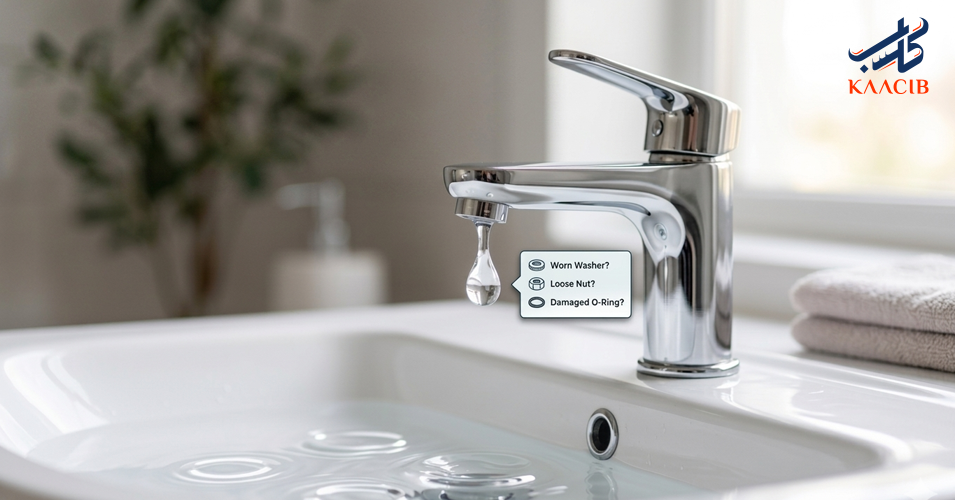
A worn washer. Older compression-style faucets use a rubber washer at the end of a stem. Turning the handle presses the washer against the valve seat to stop flow. Over time the rubber hardens, flattens unevenly, or develops small cracks along its sealing edge. When the washer no longer conforms to the valve seat surface, water finds the gap. This is the most straightforward repair in plumbing: the washer is inexpensive and accessible, provided the valve seat beneath it hasn’t corroded.
A failing cartridge. Cartridge faucets are common in Pakistani kitchens and bathrooms. They use a cylindrical cartridge containing internal seals to control water flow. When the cartridge seals degrade or mineral deposits work their way into the cartridge body, the internal mechanism can no longer close fully. The drip comes from the spout even when the handle sits at the off position. Replacing the cartridge resolves it, but the correct cartridge model has to be matched to the faucet brand and size.
A damaged O-ring. The O-ring seals the junction between the faucet body and the handle stem. When it wears out, the drip appears at the base of the handle rather than from the spout. A faucet leaking from below the handle while the spout stays dry is almost always an O-ring. The seal is small and inexpensive; identifying it correctly is the critical step.
High water pressure. A drip that appears specifically when another tap in the house runs, or that worsens noticeably in the evenings when supply pressure increases, may not originate from a worn component at all. Excessive water pressure forces water past seals that would otherwise hold. The faucet isn’t the problem in this case; the pressure feeding the whole system is. A drip that behaves this way, changing with the activity elsewhere in the plumbing, often points toward pressure conditions in the broader supply line rather than a fault inside the tap itself.
When Karachi’s Water Makes It Worse
Karachi’s water supply carries a high mineral content. The proximity to the sea, the composition of the groundwater, and the long distribution infrastructure all contribute to water that leaves deposits on surfaces it contacts regularly. The white crust forming around faucet bases, the scale buildup visible on shower heads, the staining inside kettles. These are all the same mineral accumulation process.
Inside a faucet, those deposits don’t stay on visible surfaces. They work into the cartridge body, score the valve seat surface, and coat the rubber washer with a layer that changes how it compresses. A washer in hard water loses its smooth contact edge faster than the same washer in softer water. A cartridge with mineral deposits in its internal channels struggles to seat cleanly even before the seals themselves have worn through.
The practical consequence is that faucets in Karachi tend to develop drips earlier than the same fixtures would in cities with softer water supply. A faucet that might last ten years without issue elsewhere may start dripping in five or six, not from any fault in installation but from the accumulation working against the sealing surfaces year by year.
This is also why a repair that fixes the drip initially sometimes fails within months. If the valve seat has been scored by mineral deposits, a new washer presses against a damaged surface and begins wearing against it immediately. The seat needs attention alongside the washer for the repair to hold.
What a Small Drip Costs Over Time
A single drip per second wastes roughly 30 liters of water a day. A drip that’s slightly faster, two or three per second, runs past 80 liters daily. Over a month, a persistently dripping kitchen faucet can lose more water than a household uses for several days of cooking and drinking. In a city where water supply is already irregular and water bills reflect actual consumption, the loss is not abstract.
The internal cost moves alongside the water cost. A worn washer pressing against an intact valve seat is a contained problem. The same washer, left dripping for six months, scores the valve seat through continuous contact and small grit movement. A repair that would have needed a single washer replacement now needs a seat repair or replacement as well. The gap between the two jobs, in both time and cost, grows the longer the drip is left.
Faucets dripping at their base rather than from the spout carry a different kind of risk. Water seeping from below the handle travels downward through the cabinet beneath the sink. The drip itself may be small enough to ignore, but the moisture it introduces into an enclosed wooden cabinet over weeks and months creates conditions for swelling, staining, and eventually structural damage to the cabinet and the wall surface behind it.
How We Trace Plumbing Faults at Kaacib
When a dripping faucet is reported, the fault-finding doesn’t begin by assuming a washer. It begins by observing where the drip originates, when it changes, and what the water supply and faucet type tell about which component is most likely responsible.
A drip from the spout follows a different path than one from the handle base. A drip that appears only under high pressure follows a different path than one that runs continuously. The faucet type, whether compression, cartridge, ball, or ceramic disc, determines which internal components are involved and what kind of access the repair requires.
From there, the inspection covers the sealing surfaces directly. The valve seat condition matters as much as the washer or cartridge, particularly in older faucets and in homes with hard water supply. A repair that replaces the worn component without checking the seat it contacts leaves the new part pressing against a scored surface and shortens its working life considerably.
Kaacib’s plumbing fault diagnosis in Karachi covers faucet drip tracing as part of a broader inspection, identifying whether the fault is contained to the faucet itself or connected to pressure and supply conditions further in the line.
When a Small Leak Stops Being Small
A dripping faucet rarely announces itself as urgent. It’s there in the background, counted in seconds rather than liters, noticed and then accepted as part of the kitchen’s ordinary sounds.
What changes over time isn’t the drip itself. It’s the surface the drip has been working against. The valve seat scores a little further each month. The cabinet beneath the sink absorbs moisture it was never designed to hold. The mineral deposits inside the cartridge shift from inconvenient to structural. None of these changes are visible from outside. The faucet looks exactly as it did the day the drip began.
The repairs that stay fixed are usually the ones made before the secondary damage has had time to develop. A worn washer replaced before the valve seat is scored. A leaking base addressed before the cabinet floor has softened. The drip itself is small. What it’s doing to the surfaces around it is the part that eventually determines the size of the repair.