The wings appeared on the windowsill the morning after the first heavy rain. Small, equal-sized, scattered near the kitchen window and around the light fitting in the ceiling. Whatever left them had come in overnight, circled the light, lost its wings, and moved on somewhere inside the wall.
Two nights later, cockroaches in the bathroom drain. Larger than the ones that occasionally appear in the kitchen. Three in one evening, then none the following day.
Both events felt like the monsoon brought something new into the home. Neither did. The termites that shed those wings came from a colony that has been feeding inside or beneath the building since before last summer. The cockroaches came up from the drainage system when the rain flooded it, the same pipes that serve the street outside. The monsoon didn’t create either problem. It made both visible. In the case of the termites, it marked the point where one colony decided to become two.
Flying Termites After Rain Are a Colony’s Reproductive Event, Not an Arrival
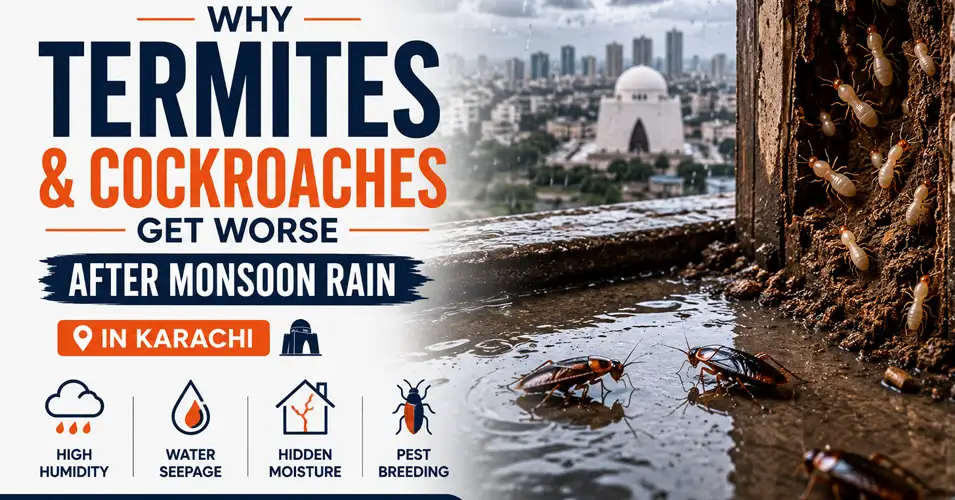
A termite colony produces winged reproductives, called alates, when it has matured to the point of being able to send out a new generation. Producing alates takes a colony roughly two to five years of feeding and growth. When rainfall brings the specific combination of moisture and humidity that signals favorable outside conditions, the colony releases those alates in a swarm. They fly toward light sources, land, shed their wings, and attempt to pair up and start new colonies elsewhere.
The wings on the windowsill are evidence of a colony that has been active long enough to reach reproductive maturity. A first-year colony produces no alates. A colony that swarmed has already been feeding for years. Whatever the swarmers were eating before the monsoon triggered their departure, including wall framing, door frames, furniture, and roof beams, they were eating it last summer as well, and the summer before that.
Flying termites appear after rain in Karachi because mature termite colonies release winged reproductives when moisture and humidity reach the levels that signal favorable conditions for new colony establishment. The rain triggers the swarm. The colony that produced the swarmers was already active before the rain arrived.
Finding flying termites or scattered wings in a Karachi home after rain means an established termite colony is active in or near the building. The swarmers themselves do not cause damage. The colony that sent them out has been feeding on wooden structures for months or longer before the monsoon triggered their emergence. Killing the swarmers addresses nothing. Finding the colony does.
Cockroaches Appearing After Rain Come From Flooded Drains, Not the Kitchen
A large cockroach appearing in the bathroom drain or kitchen sink after heavy rain is not the same pest as the small cockroaches occasionally found inside kitchen cabinets. The appearance is different, the origin is different, and the implication for the home is different.
American cockroaches, sometimes called water bugs, are large reddish-brown insects that live in drains, sewers, and the pipe network running beneath the street. Karachi’s drainage system carries sewage and stormwater through the same pipes. When monsoon rain floods that network, the cockroaches living inside it lose their habitat and migrate upward through whatever connections are available. Floor traps, gully traps, toilet connections, and pipe gaps where fixtures meet the drainage line all become entry points. They are not breeding in the kitchen. They are refugees from a flooded pipe system looking for dry ground.
Cockroaches that appear in Karachi bathrooms and kitchens after monsoon rain are typically American cockroaches emerging from flooded drains and sewer pipes. Karachi’s combined drainage network carries both sewage and stormwater through the same infrastructure. When heavy rain floods those pipes, cockroaches migrate upward through floor traps and pipe connections into homes. These are not the same as the smaller German cockroaches that live and breed indoors. Drain-emerging cockroaches disappear when drainage conditions normalize. Indoor cockroach infestations do not.
The distinction matters for the response. Spraying the kitchen for cockroaches that came from the drain addresses the wrong location. Sealing floor trap covers in bathrooms and utility areas that aren’t in regular use, checking that drain covers seat correctly, and having ground-floor drain connections inspected after a significant flooding event addresses the actual entry route.
Two Types of Termites Damage Karachi Homes in Different Ways
When a Karachi pest professional arrives at a property after a termite swarming event, the first question isn’t where the swarmers came from. It’s which type of termite produced them. The treatment, the entry point, and the structural risk are all different depending on the answer.
Subterranean termites live in the soil. They build mud tubes, small tunnels made of soil and saliva, to travel between the colony in the ground and the wood they are feeding on above. Mud tubes running along the base of a wall, inside a cabinet, or across a concrete surface to reach wooden framing are the most reliable sign of subterranean termite activity. In Karachi, where ongoing road construction and infrastructure excavation has disturbed the soil across multiple districts, subterranean colonies are being brought to the surface and displaced closer to building foundations more frequently than in a stable construction environment. A building that sat on undisturbed ground for fifteen years may now have active soil disturbance within meters of its foundation.
Dry wood termites do not need soil contact. They enter wooden structures directly through cracks, gaps, and exposed end grain in timber. Furniture, roof beams, door frames, and wooden fittings throughout the home are all potential targets. Their presence differs from that of subterranean termites. There are no mud tubes. Instead, frass, fine wood-colored granules resembling coarse dust, appears beneath or around affected wooden pieces, and the wood sounds hollow when tapped.
Signs of termite damage in Karachi homes include mud tubes running along walls or inside cabinet bases, hollow-sounding wood when tapped, discarded wings near windows and light sources after rain, blistered or bubbling paint on wooden surfaces where termites are feeding beneath, and frass near wooden furniture. Any one of these signs warrants a professional inspection rather than surface spray treatment. The structural damage that develops when termites reach wooden frames, shelving, and load-bearing elements follows the same progression covered in common woodworking problems in Karachi homes.
Monsoon Is When Existing Problems Announce Themselves, Not When They Begin
A Karachi homeowner who sees termite swarmers in July and calls a pest professional the following week will almost certainly be told that the colony has been active for at least two to three years. The monsoon triggered the swarming event. The feeding that preceded it happened silently, inside wooden elements that looked intact from the outside, across multiple summers before this one.
Subterranean termites feed from the inside of wooden elements outward. A door frame that looks solid from the room side may have been hollowed to a thin shell while the termites fed through the interior. Dry wood termites work similarly, consuming the interior of furniture while the surface shows nothing more than slightly blistered paint or a faint hollow sound when tapped. By the time winged reproductives emerge, the colony that produced them has already done its primary structural work.
In Karachi’s current construction environment, the soil disturbance from road excavation across major arteries has shortened the timeline between colony establishment and building entry for subterranean species. A colony displaced by excavation near the building doesn’t start from scratch at the building’s foundation. It arrives with an established population looking for a new food source. The result is faster infestation progress than the typical two to five year establishment timeline suggests for undisturbed conditions.
Monsoon doesn’t introduce new pests into Karachi homes. It surfaces established ones and triggers the reproductive cycle of colonies that have been active long enough to reproduce. A home inspected before monsoon gives a professional the ability to identify a colony at a feeding stage. A home inspected after swarming gives a professional evidence of a colony that has already reached reproductive maturity.
A Post-Monsoon Pest Inspection Covers Both the Entry Points and the Colony Source
Spraying visible cockroaches or swarmers after a monsoon pest event is a surface response to a structural question. A professional inspection after a swarming event or a drain-emergence cockroach event covers two things that spray treatment doesn’t.
For termites, the inspection looks for evidence of colony activity beyond the swarming event itself. Mud tubes inside wall cavities, along the building’s foundation perimeter, and inside cabinetry at ground floor level are examined systematically. Wooden elements identified as high-risk, namely door frames, structural beams at the foundation level, and built-in cabinetry with floor contact, are tested for hollowness and structural integrity. The inspection establishes whether the swarming event came from a colony inside the building or from a colony in the surrounding soil that has not yet entered the structure. The treatment differs significantly depending on which answer the inspection produces.
For cockroaches, the inspection covers the drain connections at ground-floor level, including floor-trap condition, gully-trap cover seating, and pipe gaps at fixture connections. It also assesses whether any conditions in the building are making entry easier than drain flooding alone would account for. Cockroach activity that continues well after rain has subsided and drainage has normalized is not drain emergence. It indicates an indoor population that was already present and was supplemented by the monsoon event.
The inspection report distinguishes between what the monsoon caused and what the monsoon revealed. Kaacib’s pest control assessment in Karachi covers both pest categories after a monsoon event: termite colony evidence and cockroach entry conditions. The inspection identifies what existed before the rain and what the rain introduced.
The Colony That Swarmed in July Has Been Feeding Since Last Monsoon
Last July, the same building may have had no visible sign of termites. No swarmers, no wings on the windowsill, no cockroaches beyond the occasional one in the kitchen. The absence of visible events was taken as the absence of a problem.
Below the surface, a subterranean colony was establishing itself in the soil near the foundation. Or a dry wood colony was feeding through the interior of the wardrobe in the spare bedroom, the one with the slightly blistered paint finish that was attributed to humidity. Neither produced a visible event last monsoon because neither had reached reproductive maturity. Both spent another year feeding before producing the swarmers that appeared this July.
A professional inspection before last monsoon would have found the mud tubes beginning to develop along the foundation perimeter, or the hollow section in the wardrobe panel, at a stage when the colony’s structural impact was limited and the treatment scope was narrower. An inspection after this July’s swarming event finds a colony that has already completed another full year of feeding since the last inspection opportunity.
Pest problems in Karachi don’t begin with monsoon. Monsoon is simply when the calendar of silent events inside walls and under floors produces something visible enough to prompt a search. The colony that swarmed this week has been there long enough to swarm. What it has been doing in the months before that is the part the inspection is for.