Drain overflow during Karachi monsoon is a KWSB problem. That is what most residents are told after the first spell, by building caretakers, by neighbors, by anyone who has lived through it before. Nothing inside the building caused it. Nothing inside the building can prevent it. Wait for the rain to stop and the streets to drain.
That explanation is partly true and almost entirely incomplete.
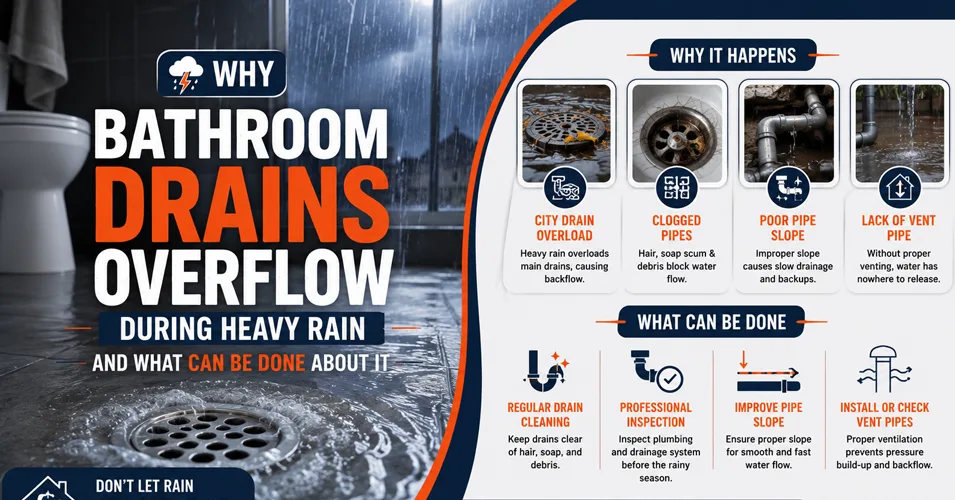
City drain pressure is the upstream cause. When Karachi’s sewage and stormwater lines, which run through the same pipes, fill beyond capacity, the pressure in those lines builds and has to go somewhere. It travels backward through every connection point between the city pipe and the buildings attached to it. The lowest drain in the lowest flat in any building along that line receives that pressure first, because it sits closest to the city pipe with the least column of water above it to push back.
The city caused the pressure. The building’s own plumbing determined where it surfaced and how much of it came through. Those are two separate problems, and only one of them belongs to KWSB.
Why Ground-Floor Bathroom Drains Overflow First During Heavy Rain
Karachi does not operate separate drainage systems for stormwater and sewage. Both travel through the same network of pipes. During heavy rain, the volume entering those pipes exceeds what the system can move toward the sea. Pressure builds inside the blocked lines and reverses direction, pushing back toward every connection point rather than forward toward an outlet.
A building connects to the city drain at a single main junction. From that junction, internal drain pipes branch upward through each floor, serving every bathroom, kitchen, and floor drain in the building. When city drain pressure reverses, it enters the building at that junction and travels upward through those internal branches. Gravity determines the result: the pressure surfaces at the lowest point it can reach without having to climb.
In most residential buildings, that lowest point is the bathroom drain on the ground floor, or the toilet connection, or the floor trap, depending on which fixture sits at the lowest elevation relative to the main junction. Upper-floor residents rarely notice anything. Ground-floor residents find the problem on their bathroom tiles.
Bathroom drains overflow during heavy rain in Karachi because the city’s drainage network uses the same pipes for stormwater and sewage. When rainfall overwhelms those pipes, pressure builds and reverses through building connections. The lowest drain in the building has the least resistance to that reversed pressure and overflows first. Upper floors experience this only when the pressure is severe enough to climb past the ground-floor fixtures.
How City Drain Backflow Differs From a Building Blockage
A building caretaker who responds to a drain overflow complaint during monsoon will often inspect the internal pipes for a blockage. Sometimes a blockage is found and cleared, and the problem seems resolved. Then the next rain spell arrives and the overflow returns. The blockage was not the cause. The caretaker solved a separate problem while the actual cause remained in place.
City drain backflow and building drain blockage produce different patterns. A building blockage causes drainage problems regardless of weather, water drains slowly or not at all, affects multiple fixtures across different floors, and does not resolve on its own when conditions outside change. City drain backflow appears specifically during or after heavy rain, concentrates in the lowest fixtures of the lowest floor, and clears once street flooding subsides and city drain pressure normalizes. The timing and location of the overflow is the diagnostic information.
If a bathroom drain overflows specifically during or after heavy rain and returns to normal function once flooding subsides, the cause is city drain backflow rather than a building blockage. A building blockage causes drainage problems regardless of rain, affects multiple fixtures, and does not resolve without intervention. Monsoon-triggered overflow that disappears between rain spells points to the city drain connection, not the internal pipes.
The internal drain pipes in a building share their infrastructure with the water supply system in one important respect: both are affected by the condition of the main building connections and the age of the pipe network. How pipe condition affects pressure in both directions is covered in detail in what causes low water pressure in Karachi homes.
How Backflow Prevention Valves Protect Buildings During Monsoon
A building’s connection to the city drain runs in both directions. Water flows out during normal conditions. During monsoon, when city drain pressure reverses, water flows in. Nothing in a standard residential plumbing installation interrupts that reversal automatically, unless a backflow prevention valve has been fitted at the main drain connection.
A backflow prevention valve contains a flap or check mechanism that allows water to exit the building freely in the normal direction. When pressure in the external drain line reverses, the flap closes, blocking the incoming flow before it reaches internal fixtures. The valve requires no manual operation. It responds to the change in flow direction and closes against it.
Most residential buildings in Karachi were not fitted with backflow prevention valves at the time of construction. Older buildings predate the widespread availability of these fittings in the local market. Newer buildings vary, some developers install them as standard, many do not. Buildings that do have them installed often have valves that have not been inspected or serviced since installation. A valve whose mechanism has seized, corroded, or accumulated debris in the flap seat will not close reliably when monsoon pressure arrives.
A backflow prevention valve is a mechanical device installed at a building’s main drain connection point. When city drain pressure reverses during heavy rain, the valve closes automatically and blocks sewage from entering the building through floor drains, toilet connections, and bathroom traps. A building without a functioning backflow prevention valve has no mechanical barrier between the city drain and its internal fixtures during monsoon.
Three Plumbing Conditions That Increase Monsoon Backflow Risk
City drain pressure during monsoon is the same for every building connected to the same line. Whether that pressure reaches the bathroom floor depends on the condition of the building’s own plumbing. Three conditions make a significant difference.
No functioning backflow prevention valve at the main drain connection. A building without a backflow valve at its main drain junction has no automatic resistance to reversed city drain pressure. Every fixture on the lowest floor sits exposed to whatever pressure the city line sends backward during a heavy rain spell. Installing a valve before monsoon arrives is the most direct intervention available at the building level.
Partial blockage in the internal drain stack. A partially blocked main drain pipe inside the building creates a secondary pressure point during backflow events. When city pressure reverses and encounters an internal restriction, the overflow surfaces higher up the pipe than it otherwise would, affecting fixtures above the ground floor and increasing the force at ground-floor fixtures. Accumulated grease, debris, or scale in the building’s main vertical drain pipe reduces the pipe’s capacity in both directions, outward during normal use, and as a buffer against incoming pressure during monsoon.
Evaporated water seals in low-use floor drains and bathroom traps. Every floor drain and bathroom trap contains a U-shaped section filled with water. That water column seals the drain against gases and, under backflow conditions, provides resistance to reversed pressure. In bathrooms or utility rooms used infrequently, a spare room, a storeroom, a servant’s bathroom that goes weeks without use, the water in the trap evaporates. During monsoon backflow, an empty trap offers no resistance. The overflow arrives faster and with greater volume than it would through a trap with an intact water seal.
What Kaacib’s Pre-Monsoon Drain Assessment Covers
A plumber cannot clear the city’s sewer lines or increase the capacity of Karachi’s drainage infrastructure. A pre-monsoon drain assessment addresses what is inside the building’s boundary, the conditions that determine how much of the city’s monsoon pressure reaches the interior.
The assessment begins at the main drain junction where the building connects to the city line. The presence and condition of a backflow prevention valve is confirmed first. If a valve is installed, it is tested for free movement of the flap mechanism and checked for debris accumulation at the seat. A valve that passes visual inspection but whose flap has corroded into a partially open position will not close under monsoon pressure. Passing visual inspection and functioning correctly are not the same thing.
From the junction, the internal drain stack is inspected for partial blockages. A drain camera, where access allows, identifies restriction points in the main vertical pipe before they become failure points during a backflow event. Grease accumulation from kitchen connections entering the stack, scale buildup in older pipes, and debris lodged at pipe junctions are the most common findings.
Floor drains and bathroom traps in low-use fixtures are checked for water seal condition and refilled where the seal has evaporated. In buildings with multiple units, ground-floor fixtures in common areas and utility spaces are the priority.
Kaacib’s drain assessment and backflow protection in Karachi covers each of these layers before monsoon season, establishing what the building can do independently of what the city’s drainage system does or fails to do.
Why Drain Problems Cost More After Monsoon Begins
A backflow prevention valve installed before monsoon season is a planned job. The main drain junction is accessed, the valve is fitted, the connection is tested. The work is done in dry conditions on a pipe carrying normal load.
The same valve installed after a sewage backflow event is a different job. The bathroom floor has been contaminated. The internal drain pipe may have received debris carried in by the reversed flow. The fixtures need inspection for damage before the pipe work begins. The caretaker has already attempted to clear what looked like a blockage. None of these conditions existed before the overflow. All of them add scope and time to work that could have been one straightforward installation.
Partial drain stack blockages follow the same pattern. A restriction found during a pre-monsoon inspection is cleared from a pipe running at normal load. The same restriction found during a monsoon backflow investigation sits inside a pipe that has just carried reversed sewage pressure, and potentially deposited debris at points throughout the internal stack in the process.
Pre-monsoon drain work in Karachi is not a precaution against a low-probability event. Sewage backflow into ground-floor fixtures happens across the city in every significant rain spell. The buildings that avoid it are the ones where someone checked the valve, cleared the stack, and refilled the traps before July ended.