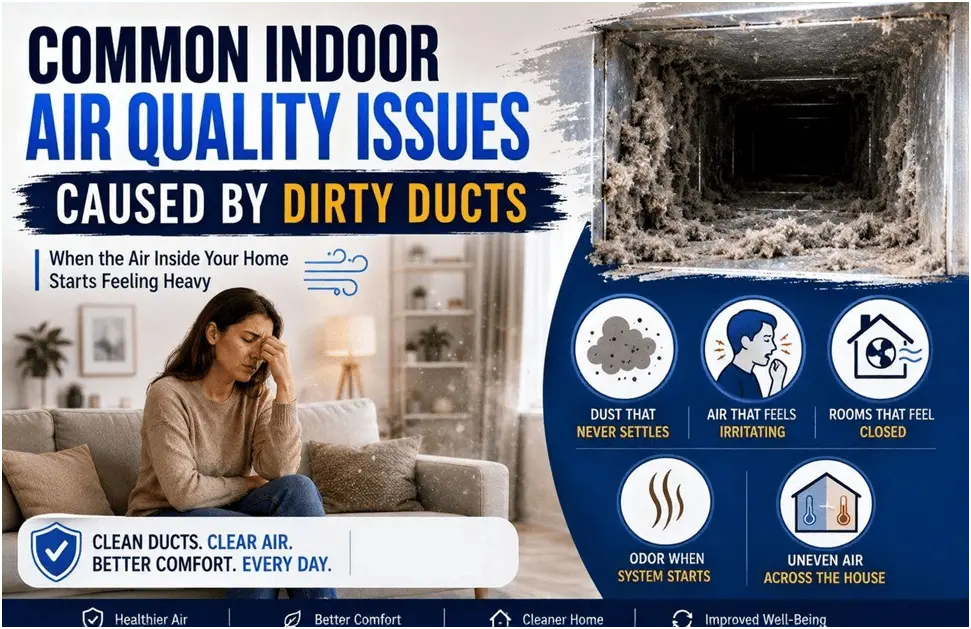
When the Air Inside Your Home Starts Feeling Heavy
The change isn’t always obvious. The room looks clean, everything is in place, yet the air feels slightly closed.
You notice it more when sitting still. The AC is running, but the space doesn’t feel fresh. Something lingers, especially in rooms that stay shut most of the day.
Dust comes back quicker than expected. You wipe surfaces, and within a short time, that same thin layer settles again.
In some homes we visit at Kaacib, people describe it as the air “not clearing out.” It doesn’t feel dirty, just not right.
That’s usually where the issue begins, not with visible dirt, but with how the air behaves inside the space.
How Dirty Ducts Change the Air You Breathe
Air moves through the same paths again and again. Whatever sits inside those ducts keeps circulating with it.
Dust doesn’t stay trapped. It gets lifted and carried into the rooms, then settles again on surfaces, fabrics, and floors. That cycle repeats every time the system runs.
Some particles are too fine to notice directly. You don’t see them, but you feel the effect over time. The air feels thicker, less clear.
In certain homes, there’s also a slight smell when the AC starts. It fades after a while, but it points to what’s sitting inside the system.
A few things usually keep moving through that airflow:
- fine dust that never fully settles
- fibers from carpets and furniture
- residue that builds up inside the ducts
- particles coming in from outside air
None of this blocks the system immediately. It just changes the quality of the air moving through the space.
Air Quality Issues That Start Showing Up Over Time
The problems don’t arrive all at once. They show up in small ways, then start connecting.
Dust That Never Really Settles:
You clean the room, and it looks fine. A day later, that same thin layer is back.
It’s not coming from one place. It keeps circulating through the system, then settling again.
Air That Feels Slightly Irritating:
Nothing strong, just a mild dryness or irritation after spending time indoors.
People don’t always link it to airflow. It just feels like the room isn’t as comfortable as it should be.
Rooms That Feel Closed Even With AC Running:
Cooling is there, but freshness isn’t. The air doesn’t feel like it’s moving properly.
Some rooms clear out faster. Others stay slightly heavy.
Odor That Appears Briefly When the System Starts:
A faint smell shows up when the AC turns on, then fades.
It usually points to what’s sitting inside the ducts rather than the room itself.
Uneven Air Across the House:
One space feels fine, another doesn’t. The difference becomes more noticeable over time.
These issues don’t stop the system from working. They just change how the space feels day to day.
How Air Quality Gradually Gets Worse Without You Noticing
Air quality doesn’t drop overnight. The system keeps running, so everything feels normal at first.
Dust builds slowly inside the ducts. Each cycle adds a little more, but not enough to notice immediately.
Airflow still works, just not in the same way. Rooms cool down, but the air doesn’t feel as clear as before.
Because the change is gradual, it blends into daily routine. You adjust to it without realizing anything has shifted.
By the time it becomes noticeable, the buildup has already been there for a while.
How Poor Air Quality Starts Affecting Daily Comfort
You don’t always notice it right away. The room looks fine, the temperature feels normal, but staying there for longer starts to feel tiring.
Air feels slightly heavier during the day. By evening, the space can feel more closed, especially in rooms that don’t get much ventilation.
People often describe it in small ways. Sitting for a while feels uncomfortable. The room doesn’t “clear out” even after the AC has been running for some time.
Sleep can feel different too. Not because of noise or temperature, but because the air doesn’t feel as easy to breathe.
Nothing stands out as a clear problem. It just feels like the space isn’t as comfortable as it used to be.
How We Identify Air Quality Issues at Kaacib
We don’t start with assumptions. The first step is seeing how the air behaves inside the space.
Some signs show up quickly. Dust patterns near vents, uneven airflow across rooms, or that slight heaviness people describe when sitting for a while.
We usually check how air moves when the system is running. Not just whether it’s coming out, but how evenly it’s distributed and how the room responds.
In certain cases, the issue isn’t visible at all. It shows up through repeated patterns. Dust returning too quickly. Rooms feeling different from each other.
Once the behavior is clear, we trace it back to the duct system.
You can see how this is handled in detail through our Kaacib duct cleaning service.
The focus stays on identifying where the change is happening, not just reacting to the symptoms.
Keeping Indoor Air Clear Without Letting It Slip Again
Air quality doesn’t stay stable on its own. Small habits usually decide how quickly it starts changing again.
- Let air circulate whenever possible
Even short periods of ventilation help clear what stays trapped indoors.
- Clean vent covers, not just visible surfaces
Dust builds there first, then gets pulled back into the system.
- Avoid running the system during heavy indoor dust
Renovation work or deep cleaning can push more particles into the ducts.
- Keep high-fabric areas in check
Carpets, curtains, and upholstery release fibers that keep moving through the air.
- Pay attention to early changes in how the room feels
Slight heaviness or uneven airflow usually appears before bigger issues.
None of this replaces proper duct cleaning. It just slows down how quickly the air starts feeling off again.
Final Thought on Indoor Air Quality and Ducts
Air doesn’t turn poor overnight. It changes slowly, usually in ways that are easy to ignore.
A room can look clean and still feel off after some time. That difference often comes from what’s moving through the system, not what’s visible on the surface.
From what we see at Kaacib, early attention makes the biggest difference. Once the air starts feeling heavy or inconsistent, the buildup has already been there for a while.
The system doesn’t need constant work. It just needs to be checked before the change becomes part of the everyday environment.