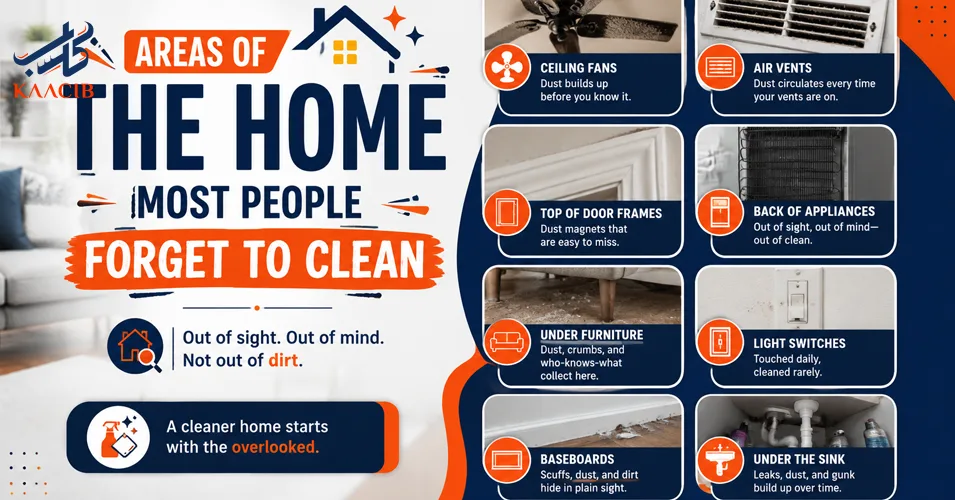
The floors are clean. The kitchen counter has been wiped down. The bathroom was scrubbed yesterday. The home feels in order.
And yet the top of the refrigerator hasn’t been touched in months. The AC vent in the bedroom is grey with dust that has been there since before summer started. The rubber seal around the refrigerator door has a faint dark line along its inner edge that wasn’t there last year. The ceiling corner above the shower has something growing in it that a quick glance from the doorway doesn’t show clearly.
A clean home and a thoroughly cleaned home are not always the same thing. The difference usually isn’t effort or frequency. It’s the areas the routine was never built to include.
Cleaning by Habit
A cleaning routine forms the first time a space is cleaned. Whatever was addressed that day, in whatever order, becomes the template. The counter gets wiped before the sink. The floor gets swept after the surfaces. The bathroom follows the kitchen. The routine repeats, and over time it becomes automatic enough that it no longer requires thinking.
What it also stops doing is expanding.
The top of the wardrobe wasn’t part of the original routine because it wasn’t visibly dirty when the home was first moved into. The kitchen exhaust hood wasn’t included because the stovetop was the obvious priority. The AC vents weren’t considered because the unit was new. Each of these areas was implicitly filed as either not necessary or not urgent, and that filing persisted long after the conditions changed.
A professional cleaner doesn’t work from a personal routine. They work from a checklist built by observing what gets missed in home after home, year after year. The areas on that checklist are consistent precisely because the habit-driven gaps are consistent. The same surfaces get overlooked in most homes, for the same reasons.
The Kitchen’s Forgotten Layer
The stovetop gets cleaned. The sink gets scrubbed. The counter around the cooking area gets wiped after every use in most households. Everything at eye level and arm’s reach stays in relatively good condition. The kitchen’s problem areas sit just outside that zone.
The exhaust hood above the stove. In a kitchen where daily cooking involves oil, the exhaust hood accumulates grease faster than most surfaces in the home. The underside of the hood, the filter inside it, and the fan behind the filter collect a layer of congealed grease and dust that builds steadily with every cooking session. In Karachi’s humidity, that layer doesn’t stay dry. It becomes a surface where airborne particles collect and microbial growth takes hold. Most households clean the stovetop directly below it without ever looking up.
The top of the refrigerator. Elevated, out of the natural sightline, and positioned near a heat-producing appliance, the top of the refrigerator accumulates a layer of dust and grease that combines into a film difficult to remove once it has been there for several months. In kitchens without strong ventilation, cooking vapors rise and settle on horizontal surfaces above eye level. The refrigerator top collects this continuously.
The rubber door seal. The gasket running around the refrigerator door closes against the frame hundreds of times a year. The folds in the rubber trap moisture, food particles, and debris from hands touching the door repeatedly. Mold establishes itself in those folds and progresses inward along the seal’s inner edge. It is rarely visible without pulling the seal slightly away from the door frame to inspect it directly. By the time it’s noticeable from the front, it has usually been developing for a long time.
What the Bathroom Misses
A bathroom cleaned from the doorway looks different from a bathroom cleaned entirely. The floor is clean. The basin is clean. The mirror has been wiped. From the threshold, everything looks in order. The areas that haven’t been addressed are the ones that require stepping further in, looking up, or reaching behind a fixture.
Ceiling corners and grout lines. Bathrooms in Karachi’s climate deal with condensation that clings to surfaces after every shower, particularly in rooms without effective ventilation. Moisture that reaches the ceiling corners and the grout between wall tiles doesn’t dry out quickly. Mold establishes itself in these areas within weeks of regular bathroom use and spreads outward from the corner in a pattern that stays invisible from the doorway until it covers a significant area. Cleaning grout lines requires a stiff brush and deliberate effort. Ceiling corners require a tool with reach. Neither is part of a standard wipe-down.
The area behind and beneath the toilet. The floor behind the toilet and the junction between the toilet base and the floor are among the most consistently missed areas in residential bathrooms. The reach is awkward, the visibility is low, and in most cleaning routines the toilet is cleaned from the front and sides without the back being addressed. Moisture and residue accumulate in that space steadily. In bathrooms with older floor sealing or slight floor irregularities, the buildup works into the grout around the toilet base.
The exhaust fan or ventilation grille. Bathroom ventilation grilles collect dust on their outer surface and, if the fan behind them is rarely cleaned, on the fan blades as well. A grille covered in dust restricts the airflow it was installed to provide. In a bathroom that already has humidity problems, a partially blocked exhaust fan makes those conditions worse. The grille is usually located near the ceiling, which places it outside the area most people look at or reach during a standard cleaning.
Rooms That Circulate What They Collect
Most missed areas in a home accumulate passively. The dust on top of the wardrobe sits there until it’s addressed. The grease on the exhaust hood stays where it landed. The AC vent operates differently.
A vent cover that hasn’t been cleaned through a full Karachi summer has been collecting dust since the unit started running in April. Every hour the AC operates, air from the room passes through or across that accumulated layer and returns to the room carrying a portion of what was on it. The dust, the mold spores that form in humid conditions on the vent surface, the fine particulate matter from Karachi’s urban air, and all of it cycles continuously through the space where the household sleeps, eats, and spends most of its time.
Cleaning a vent cover takes a few minutes. What it addresses is not cosmetic. The difference between a vent cleaned at the start of summer and one that hasn’t been touched in two seasons shows up in the air quality of the room, not just in the appearance of the grille.
The filter inside the unit compounds this further. Dust that passes through a dirty vent cover reaches the filter, reduces its efficiency, and forces the unit to work harder to move the same volume of air. A blocked filter in a Karachi summer isn’t just an air quality problem. It’s a load on the AC system that shows up in electricity consumption as well.
The surfaces where dust and contamination settle after circulating through a room are a separate concern, one that extends beyond the areas cleaned or missed and into how surfaces in regular use become vectors for contact. That pattern is covered in how germ hotspots develop in homes and offices.
The Surfaces a Routine Doesn’t Reach
Beyond the kitchen and bathroom, the areas most consistently missed follow a common characteristic: they require either a step stool to access, deliberate movement of furniture, or a task that isn’t part of daily or weekly maintenance cycles. A professional cleaner addresses all three categories. A standard home routine addresses almost none of them.
Tops of wardrobes and overhead cupboards. The horizontal surfaces above eye level in bedrooms and storage areas collect dust that falls when the wardrobe door is opened or when anything stored on top is moved. In Karachi’s dusty urban environment, these surfaces accumulate a visible layer within weeks of being cleaned. Because they’re rarely looked at directly, the accumulation continues undisturbed for much longer than surfaces at eye level.
Curtains and blinds. Curtains hang in front of windows and collect dust from two directions: from the room air that circulates against their surface, and from the window gap they cover. In homes where curtains are opened and closed daily, the fabric traps and releases dust with each movement. Heavy curtains in particular can hold a significant volume of accumulated dust that distributes into the room every time they’re drawn. Blinds collect dust along each horizontal slat, and a blind that hasn’t been wiped in several months carries enough accumulated material to coat a hand visibly when run along the slats.
Mattresses. A mattress is used every night and almost never cleaned. Dust accumulates on the surface beneath the fitted sheet and, in mattresses that haven’t been vacuumed, inside the fabric layers as well. In Karachi’s humidity, a mattress that retains moisture from body heat without adequate ventilation can develop conditions for mold growth in its lower layers. Rotating the mattress periodically and vacuuming the surface before replacing the bedding addresses this. Neither is typically part of a weekly routine.
Under and behind furniture. The floor directly beneath sofas, beds, and heavy storage units is cleaned far less frequently than open floor areas. Dust accumulates in these spaces and distributes into the room when air movement disturbs it, when furniture is shifted, or when someone sits on a sofa and the cushions compress against the base. In rooms where these areas haven’t been accessed in months, the accumulation is substantial.
How We Approach Deep Cleaning at Kaacib
A deep clean at Kaacib starts from a different position than a routine clean. The surfaces that get addressed in a standard session are noted and set aside. What the assessment focuses on first is everything outside that list.
In practice, that means working through the kitchen from above eye level downward: the exhaust hood and filter, the tops of cabinets and the refrigerator, the seal and the spaces behind appliances pulled slightly from the wall. In the bathroom, it means the ceiling corners and grout lines before the floor, and the exhaust fan before the basin. In living areas and bedrooms, it means the vent covers, the tops of wardrobes, the curtains and blinds, the floor beneath furniture that hasn’t been moved in months.
Each area gets assessed before it’s cleaned, because some require different materials or tools than standard surface cleaning. Grout mold needs a different approach than dust accumulation. A grease-coated exhaust filter is a different task from a dusty vent cover. Getting to the area is part of the job; cleaning it correctly once there is the other part.
Kaacib’s deep cleaning service in Karachi covers the full range of consistently missed areas, working through each room in a sequence built specifically around what a routine doesn’t reach.
What Usually Gets Missed Again First
After a thorough clean, every surface in the home is addressed. The exhaust hood is clear. The bathroom ceiling corners are clean. The vent covers have been washed and replaced. For a period, the home is genuinely clean in a way it may not have been for some time.
Then the routine resumes.
The stovetop gets wiped after cooking. The bathroom floor gets cleaned on schedule. The kitchen counter stays in the rotation. The exhaust hood doesn’t. The vent covers get noticed briefly when the AC is turned on for summer and then not again. The ceiling corner in the bathroom is outside the area that gets looked at during a standard clean.
Within a few months, the same areas that required the most attention during the deep clean are accumulating again. Not because the routine became careless, but because the routine was rebuilt around the same habits it always had. The areas that were outside it before the deep clean drift back outside it after.
The ones that return to neglect fastest are almost always the ones that require the most deliberate effort to include: anything above eye level, anything behind a fixed appliance, anything that needs a tool or a step to access. They were excluded from the original routine for a reason. Keeping them in the new one requires a decision, not just a habit.