
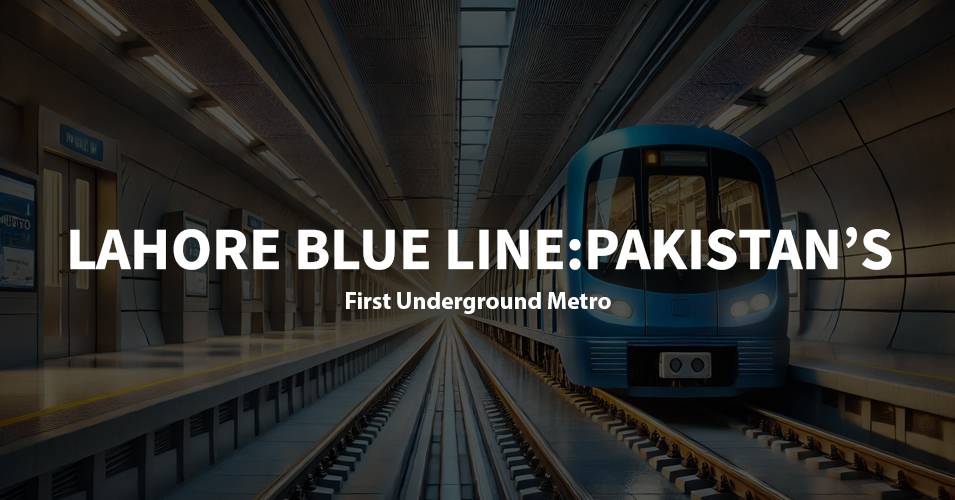
The Punjab government has started early planning work on what could become Pakistan’s first fully underground metro rail system. The proposed project, called the Blue Line, is designed to improve public transportation in Lahore and provide a faster, more reliable travel option for daily commuters across the city.
Officials have initiated feasibility assessments, route planning, and technical design studies as part of the preliminary phase. Authorities aim to evaluate the project’s financial, engineering, and environmental requirements before moving toward formal approval and construction.
Planned Underground Corridor
According to initial proposals, the Blue Line will stretch roughly 27 kilometers, running entirely underground from Valencia Town to Babu Sabu Chowk. If finalized, this route will pass through several densely populated and commercially active areas of Lahore.
The proposed corridor is expected to connect major districts such as Johar Town, Faisal Town, Garden Town, Kalma Chowk, Gulberg, Jail Road, Ferozepur Road, Wahdat Road, and Allama Iqbal Town. These neighborhoods are known for heavy traffic flow and high commuter demand, making them key locations for a rapid transit system.
By linking these areas through an underground network, the project aims to reduce pressure on Lahore’s busy road infrastructure.
Expected Passenger Capacity
Transport planners estimate the Blue Line could handle over 250,000 passengers daily once the system becomes operational. This capacity would make it one of the largest additions to Lahore’s public transport network in recent years.
The metro system is also expected to integrate with existing transit projects such as the Orange Line Metro Train and the Lahore Metrobus, creating a more connected urban transportation system.
Urban transport experts believe that improved integration between different transit modes could significantly shorten travel times and encourage more residents to shift from private vehicles to public transport.
Estimated Cost and Funding
Early projections suggest the project could cost more than Rs. 600 billion, making it one of the most expensive infrastructure initiatives in Punjab’s history.
Reports indicate that international financial institutions and development partners from China, Japan, and France have shown preliminary interest in supporting the project through financing, technical expertise, or public-private partnerships. Final funding arrangements will be decided after the feasibility report is completed.
Why the Entire Route Will Be Underground
Earlier concepts proposed a combination of elevated and underground tracks. However, planners have now opted for a fully underground design.
This approach is intended to minimize disruptions to Lahore’s already congested roads and protect existing urban infrastructure. Underground systems also reduce noise pollution and preserve surface space in densely populated areas.
Many major cities around the world—including London, Paris, and Tokyo—rely heavily on underground metro networks for precisely these reasons.
Potential Benefits for Lahore
If completed, the Blue Line could bring several long-term advantages to the city, including:
- Reduced traffic congestion on major roads.
- Faster travel between residential and commercial districts.
- Lower vehicle emissions and improved air quality.
- More reliable daily commuting options.
- Increased economic activity around metro stations.
Urban planners also note that metro corridors often encourage transit-oriented development, where residential, retail, and business projects grow around transport hubs.
What Comes Next
The Punjab government has instructed the transport department to accelerate feasibility and engineering studies. Once the analysis is finalized, officials will present a detailed report outlining the project’s final route alignment, construction timeline, funding structure, and environmental impact.
If the project receives approval in upcoming development budgets and financing agreements are secured, construction could begin soon after, with officials estimating a potential three-year completion period.
Should the Blue Line move forward as planned, it would represent Pakistan’s first completely underground metro system, marking a significant milestone in Lahore’s efforts to modernize its public transportation infrastructure and accommodate the city’s growing population.