
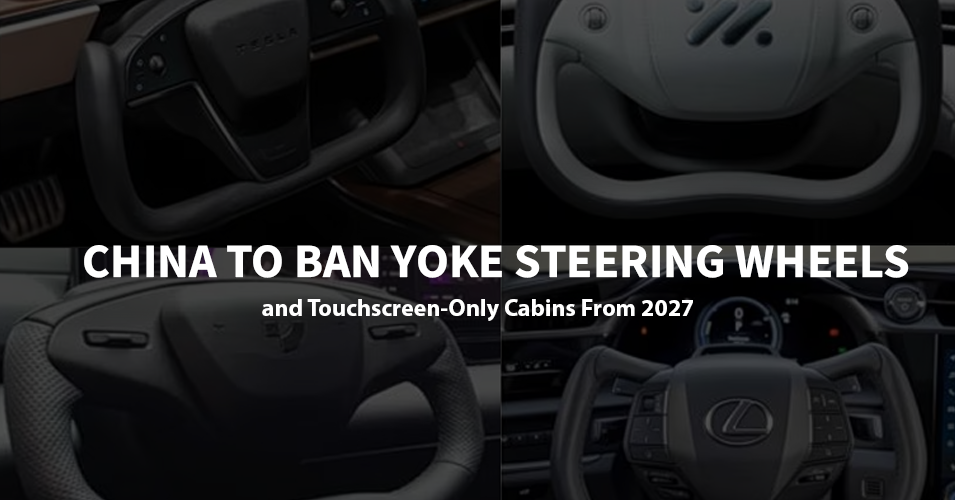
China is preparing a major update to its vehicle safety rules that will outlaw yoke-style steering wheels and significantly restrict fully digital, screen-based interiors starting January 1, 2027.
The new regulations are being drafted by Ministry of Industry and Information Technology and will apply across the passenger-car market in China.
The policy shift directly targets design trends popularised by Tesla, including half-wheel steering systems, flush door handles and large touchscreen-only control layouts.
Why China is tightening interior safety rules
Under the draft steering regulation, vehicles must pass impact tests at 10 separate points around the steering rim — including the upper section. Because yoke wheels have no continuous rim, they fail to meet this requirement.
Chinese regulators say yoke-style designs allow a driver’s body to slide forward more easily during a collision and can interfere with the intended deployment path of airbags. This can increase the risk of chest, head and facial injuries in real-world crashes.
Government crash data shows that around 46% of driver injuries are linked to the steering system or steering column, making it one of the most common sources of in-cabin harm.
Flush door handles and emergency exits also targeted
China has already moved to restrict hidden and flush door handles after multiple incidents where passengers were unable to exit vehicles following power failures or post-crash fires.
Under the updated rules:
- Vehicles must provide mechanical door releases both inside and outside the car.
- Emergency exits must be clearly marked within the cabin.
- Electronic-only door mechanisms will no longer be acceptable as the sole release method.
Automakers estimate that redesigning doors, interior structures and wiring systems could cost up to 100 million yuan per model.
Big screens face new limits
Regulators are also preparing rules to curb what they describe as “excessive” in-car displays. The draft standards would require dedicated physical controls for:
- Turn signals
- Hazard lights
- Gear selection
The aim is to reduce driver distraction and ensure that critical functions remain accessible even if the central screen fails or the vehicle loses electrical power.
This move aligns with a broader global safety trend that increasingly favours tactile controls for essential driving functions, especially as complaints about touch-only interfaces grow among both drivers and safety agencies.
Transition period and industry impact
China plans to offer:
- A 13-month grace period for models with already-approved yoke or half-wheel steering systems.
- A longer transition window for some door-handle designs, extending until January 2029.
Although the rules apply domestically, China’s position as the world’s largest vehicle manufacturing hub means the changes will likely influence export models as well.
For markets such as Pakistan, where Chinese electric vehicles are rapidly gaining market share, future imports are expected to feature more traditional steering wheels, visible door handles and a return to physical buttons for core functions.
What was missing from earlier reports
Industry analysts note that the updated safety framework is also expected to reshape future cockpit layouts, encouraging:
- Standardised steering-wheel shapes across brands
- More uniform placement of safety-critical switches
- Simplified driver displays to reduce cognitive load
The rules are widely seen as a signal that China is shifting its regulatory focus from futuristic styling toward crash survivability, usability in emergencies and post-impact escape, even if that means rolling back some high-profile design trends from the early EV boom.