
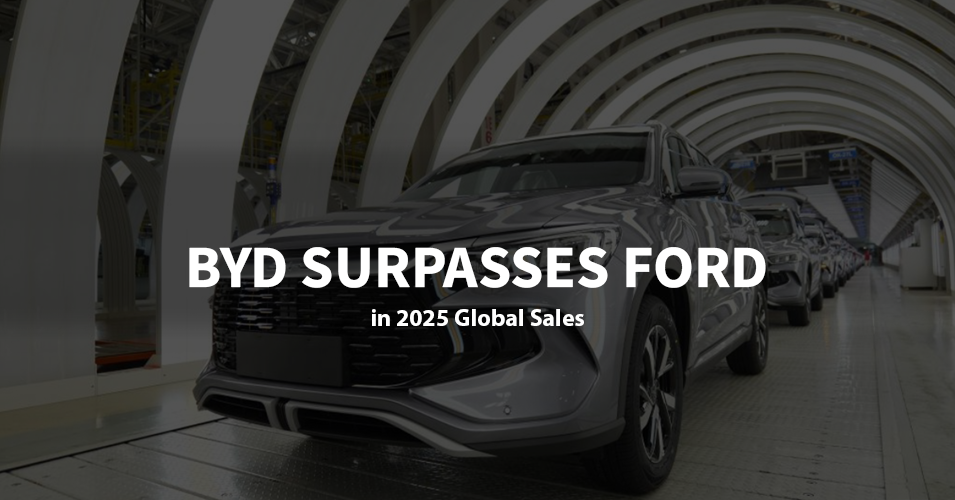
Chinese automotive giant BYD has achieved a historic breakthrough in 2025, securing a spot among the world’s top-selling car manufacturers and surpassing Ford in total global vehicle sales for the first time.
According to industry figures, the Shenzhen-based company delivered around 4.6 million vehicles last year, edging ahead of Ford’s approximately 4.4 million units. The milestone marks a symbolic shift in the global automotive hierarchy, as a Chinese automaker overtakes one of America’s most iconic legacy brands in overall sales volume.
EV-Only Strategy Pays Off
Unlike many traditional carmakers balancing internal combustion and electric lineups, BYD has focused exclusively on new energy vehicles (NEVs), including battery electric vehicles (BEVs) and plug-in hybrid electric vehicles (PHEVs). This singular strategy has allowed the company to streamline production, scale battery technology, and rapidly expand its model range.
In 2025, BYD not only maintained its leadership position in the NEV category for the fourth consecutive year but also reportedly delivered more pure electric vehicles than Tesla, its long-time global EV rival. This is particularly significant given Tesla’s dominance in the fully electric segment over the past decade.
A major factor behind BYD’s growth is its vertical integration. The company manufactures its own batteries through its subsidiary FinDreams and produces key components in-house, helping reduce costs and shield itself from supply chain disruptions. Its proprietary Blade Battery technology has also strengthened its competitive edge in safety and cost efficiency.
Exports Drive Global Expansion
International expansion played a crucial role in BYD’s record-breaking year. The company exported more than one million vehicles in 2025 — a dramatic increase compared to previous years. Growth was especially strong in Europe, Southeast Asia, Australia, and Latin America, where competitively priced EVs are gaining traction.
BYD has also accelerated overseas production and assembly plans, investing in manufacturing facilities outside China to avoid tariffs and improve regional supply efficiency. This move signals its intention to become not just a Chinese export success story, but a truly global automotive brand.
What This Means for the Industry
BYD’s rise highlights the rapid transformation underway in the global auto industry. Electrification is reshuffling long-standing rankings, and companies that were once considered challengers are now setting the pace.
Legacy automakers that have been slower to transition to electric vehicles face mounting pressure, particularly as Chinese manufacturers combine advanced EV technology with aggressive pricing strategies. BYD’s growth could intensify competition in emerging markets where affordability plays a decisive role in EV adoption.
Additionally, the shift may influence global pricing trends, supply chains, and dealership networks as Chinese EV brands continue expanding into new territories.
What Comes Next?
Final confirmation of the complete 2025 global auto sales rankings from leading industry analysts is expected soon, which will clarify BYD’s exact standing among the world’s largest carmakers.
Regardless of the final tally, BYD’s performance underscores a broader reality: the center of gravity in the automotive world is moving rapidly toward electrification — and increasingly toward China.