
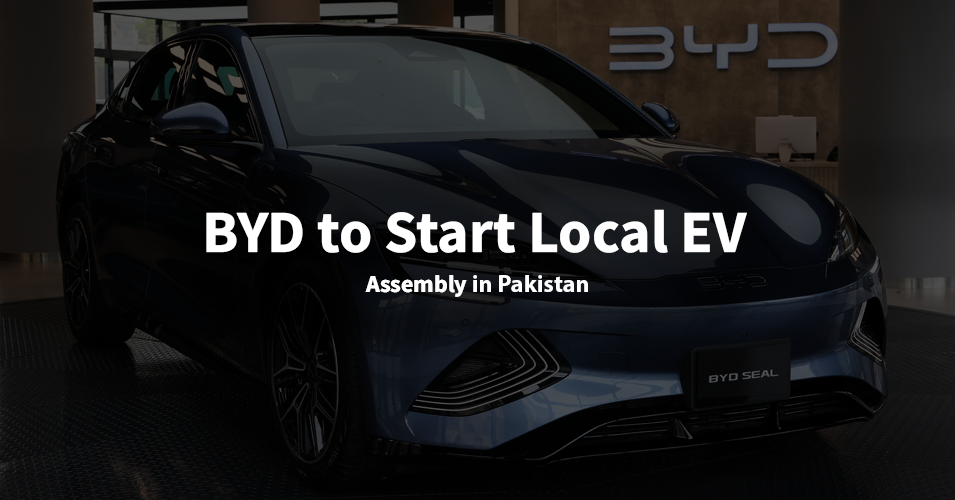
China’s leading new-energy vehicle maker BYD is preparing to transition from an import-only brand to a local vehicle assembler in Pakistan, marking a major shift in the country’s rapidly evolving auto industry.
The company plans to establish an assembly facility near Karachi in collaboration with Mega Motor Company, its official local partner. The project will be backed by an estimated investment of around US$150 million, with production expected to begin between July and August 2026, according to a senior executive at Mega Motor Company in comments reported by Nikkei Asia.
The proposed plant is designed for an initial capacity of approximately 25,000 vehicles per year, operating on double shifts. The assembly focus will cover fully electric vehicles (EVs) as well as plug-in hybrid electric vehicles (PHEVs). If timelines hold, BYD will become the first global-scale EV specialist to locally assemble electric cars in Pakistan.
Local assembly is expected to significantly reduce price pressure created by high import duties, improve delivery timelines, and stabilize supply for dealerships—key hurdles that have limited EV adoption so far.
A Market Traditionally Dominated by Japanese Brands
For decades, Pakistan’s passenger vehicle sector has been led by Japanese manufacturers such as Toyota, Suzuki, and Honda. Their deep localization, dealer networks, and dominance in the small-car and sedan categories created a high entry barrier for new brands.
However, rising prices, limited model refresh cycles, and slower adoption of advanced driver-assistance systems (ADAS) and connected infotainment features have gradually weakened that long-standing advantage.
BYD’s local production strategy directly raises competitive pressure on incumbents—particularly in three areas that have historically lagged in Pakistan:
- Depth of hybrid and electrified powertrain offerings
- Feature-to-price value (ADAS, digital cockpit, extended warranties)
- Faster product refresh cycles in line with global technology trends
Pakistan’s New Wave of Chinese Local Assembly
BYD will not be entering an empty field. A growing number of Chinese brands have already committed to local CKD operations or announced assembly programs.
- Chery, through Master Group, has introduced locally assembled models under its Pakistan operation.
- Jetour has entered the market with backing from United Motors, with local assembly highlighted in industry reporting.
- Chery’s export brands Jaecoo and Omoda are being introduced via NexGen Auto, part of the wider Nishat Group ecosystem.
- Changan continues its local operations through Master Changan, while its new-energy sub-brand Deepal is positioned within the same platform.
Industry platforms such as PakWheels have already reported on several locally assembled Chinese models now entering showrooms.
This means BYD’s entry will intensify competition not only with Japanese brands, but also within a fast-growing Chinese manufacturing cluster.
What’s Missing So Far – and Why It Matters
While the announcement confirms scale and timing, several critical details are still undisclosed and will largely determine BYD’s real market impact:
- Model selection: Whether BYD chooses compact crossovers, sedans, or affordable city EVs will shape how quickly it can reach mass buyers.
- Localization depth: True cost reductions depend on how quickly components such as wiring harnesses, body parts, and interior trims can be sourced locally rather than imported.
- Battery logistics and safety standards: BYD’s strength lies in in-house battery technology. Local storage, transport protocols, and technician training will be essential for after-sales confidence.
- Charging ecosystem partnerships: Without a parallel rollout of reliable fast-charging corridors and dealership chargers, EV adoption may remain limited to major urban centers.
- Resale and warranty structures: Long-term battery warranties and certified resale programs could become major differentiators in a price-sensitive market like Pakistan.
Policy Tailwinds Favor New Entrants
Pakistan’s Auto Industry Development and Export Policy (2021–26) offers tariff concessions and reduced duties on imported parts for new manufacturers. In parallel, the government’s national electrification roadmap targets 30% of all new vehicle sales, imports, and production to be electric by 2030.
Lower import duties on EV components and preferential electricity tariffs for charging infrastructure further strengthen the case for large, vertically integrated players—an area where BYD has a structural advantage due to its control over batteries, motors, and power electronics.
Takeaway
BYD’s plan to locally assemble vehicles in Pakistan represents a meaningful escalation in the country’s shift toward electrified mobility. If the project stays on schedule, locally assembled BYD EVs and PHEVs could begin appearing in showrooms by late 2026.
The real test will come once BYD reveals its first locally built models, pricing strategy, and charging-network partnerships—factors that will decide whether EVs finally move beyond early adopters and into Pakistan’s mainstream car market.